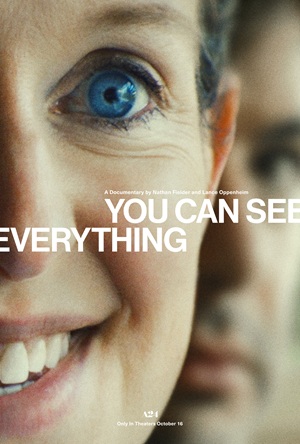
You Can See Everything (2026) 
by Sara Michelle Fetters - October 16th, 2026 - Four-Star Corner Movie Reviews
Groundbreaking You Can See Everything Isn’t About Seeing It All
It’s easy to go into directors Nathan Fielder and Lance Oppenheim’s mind-blowing documentary You Can See Everything and assume you’re going to get fresh insights into who controversial Theranos founder Elizabeth Holmes is and whether or not the charismatic tech entrepreneur deserved an 11-year prison sentence after being convicted of defrauding investors in January of 2022. It’s right there in the title. You, the viewer, get to see everything. Nothing will be hidden. It will all be there on the screen.
But seeing isn’t always understanding. Don’t let the title fool you.
Fielder, invited by Holmes and her husband, Billy Evans, to document the former’s last 34 days of freedom before she reports to a Federal prison in Texas and ask every question he wants, no restrictions, quickly discovers truth isn’t that easy to ascertain, no matter how unprecedented the access to the person at the center of a complicated mystery. Is he being conned? Are the pair putting on an elaborate act to engender Fielder’s empathy so he’ll deliver a sympathetic portrait of Holmes? Or is she still convinced she did nothing wrong and that the Theranos device worked as described even though 12 jurors vociferously felt Federal prosecutors proved otherwise?
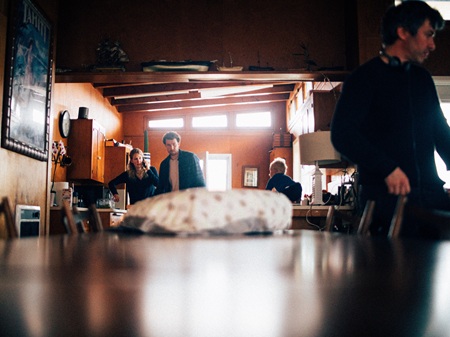
In all my years as a critic, heck, as a movie lover going back to my childhood, I can’t say I’ve ever seen anything like what Fielder and Oppenheim have delivered with this documentary. Holmes and Evans seemingly do not keep Fielder from recording whatever he wants to, even inviting him to live with them in the guest house of the beachside California rental they’re staying at until they have to move to Texas. His cameras don’t miss anything. They’re everywhere.
During these 34 days, Fielder asks Holmes every conceivable question. He tests her knowledge and her recollections of what Theranos was doing. The filmmaker pushes her to admit the small device, which was billed as being able to run a myriad of blood tests with only a prick of the finger and a drop of blood, couldn’t really do what she claimed, only for Holmes to remain steadfast in her apparent belief in the validity of her past statements.
One of this section of the documentary’s best moments is when Fielder introduces Holmes to Bud Abbott and Lou Costello’s iconic “Who’s on First?” comedy routine. His reasons for showing it to her make perfect sense when juxtaposed with Holmes’s comments on the Theranos device. Watching her react to the routine, immediately followed by her understanding as to why it is funny, is otherworldly. And yet, you can’t help but wonder: is this response genuine? Or is she playing Fielder in some way to confuse him as to why she seemingly can’t change a syllable of her wording when she describes the viability of the Theranos device?
But this half of the film, for all its raw frankness and (quite literally) naked urgency, isn’t nearly as groundbreaking or boundary-pushing as what happens next. It’s after Holmes goes to prison and Fielder soldiers on for two more years investigating when things take a stunning turn. Revelations about Evans cloud everything. Conversations between the documentarian and his subject suddenly need to be re-enacted (and re-evaluated). Docu-fact and docudrama collide head-on when Holmes’s husband and a Hollywood personality meet in the former’s Texas home and get into a fiery debate.
There’s more, much more, and while I want to go into it all, I’m trying not to. The surprises Fielder has in store should be experienced with as little foreknowledge as possible. At the film’s core, however, is an examination of how public discourse and perception shape reality and, like that famous speech in The Man Who Shot Liberty Valance made clear in 1962, when the legend becomes fact, that’s what gets printed (and subsequently indelibly imprinted upon public consciousness).
But what happens to fact after that? Fielder realizes he’s been shaped by public perception as much as anyone. Whether that’s through the news media or by watching an Emmy-winning docudrama, he’s made assumptions about Holmes that he’s now struggling to reconcile now that he’s started to get to know her personally. Her story has, in a strange way, become his story. More, it’s also become the audience’s story, as what Fielder has learned throughout this surreal enterprise has more to do with society and humanity at large, especially in this digital age, than it does with Theranos or its founder.
All of this puts the filmmakers in a tight spot. Fielder breaks one of the cardinal rules of documentary storytelling and becomes a character in the very true-life drama he’s attempting to document. But decisions are made even earlier that also cloud the issue, ones that force the film’s producers and its distributor, A24, into a corner where they must determine if subject accessibility is worth the cost of obtaining it. Things are cloudy long before Fielder takes up residence with Holmes, Evans, and the pair’s two children; the reveal as to why this is the case is a giant slap in the face to all involved (including the audience), and it’s guaranteed to leave a permanent mark.
Events culminate with a conversation with Holmes two years into her Texas incarceration. It’s re-enacted, as cameras and recording devices are not allowed inside the prison. Fielder tries to bring clarity to everything he’s witnessed, but even this ends up being subject to interpretation. He can’t decide on the exact wording of all that they discussed, and he and his re-enactment partner diligently work overtime on every syllable of the script before performing this interview for the audience’s consumption.
And maybe that is the point. No matter how hard you try, no matter how deep you dig, sometimes the truth isn’t as clear or as obvious as it may initially seem. As for seeing everything, the only way to do that is to look into the mirror and understand that, no matter how much you want to, no matter how hard you try, you’re not always going to like what you see. What’s looking back at you might still be an illusion.
You Can See Everything isn’t one of the best films of the year; it’s one of the greatest of the 21st century.
– Review reprinted courtesy of the SGN in Seattle
Film Rating: 4 (out of 4)