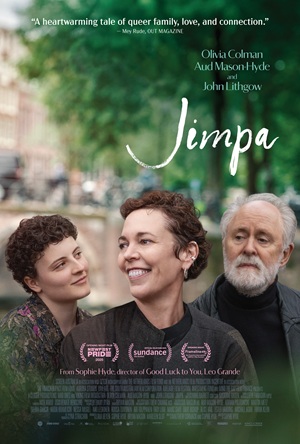
Delicately Lithe Jimpa Explores Gender, Family, and Memory with Introspective grace
Veteran filmmaker Hannah (Olivia Colman) is fleshing out her next project, a story inspired by her and her sibling Emily’s (Kate Box) complicated relationship with their Gay activist and professor father Jim (John Lithgow) when they were children. Her goal, much to the befuddlement of her backers, is to craft a story “without conflict” and instead a tale of people traversing the highs, lows, and in-betweens of their daily lives. She feels such a scenario would be far more emotionally authentic than your typical memory-based melodrama.
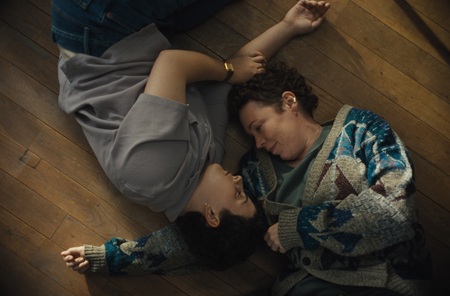
Not that Hannah’s relationship with Jim is free from conflict. On the contrary. On the eve of the family visiting Jim at his home in Amsterdam, Hannah’s nonbinary child, Frances (Aud Mason-Hyde), has proclaimed that they want to spend the next year living with their grandfather at his request. This has her extremely worried, and for good reason. While she loves her father, Hannah is still wary of his selfishness and wild mood swings, behaviors Frances has thankfully never experienced firsthand without their mother’s protection.
What follows is a time-bending scenario where Hannah must reconcile the fanciful and positive stories she’s been telling about Jim to Frances with the far pricklier, and sometimes deeply upsetting, reality of who he actually is. While her father is a good man, empathetic and caring to a fault, the activist is oftentimes all too ready to jump feet first into causing provocative and raucous trouble, even when the situation requires a gentle touch.
Additionally, after recovering from a recent stroke, his memory isn’t what it once was, and the same goes for his temperament. More importantly, while Jim loves and adores Frances, he’s prone to callously misgender them at the drop of a hat, almost as if he doesn’t think their gender nonconformity fits his traditionalist attitudes as they pertain to Gay, Lesbian, or Trans identities. And don’t get him started on discussing his views on bisexuality. Forget a few minutes (or even a couple of hours), that could start an argument that could last several insufferable days.
Fresh off her 2022 sensation Good Luck to You, Leo Grande, starring a luminous Emma Thompson, director and co-writer Sophie Hyde returns with the ambitious, delicately lithe Jimpa, a multigenerational, frequently hallucinatory drama inspired by her own family’s history and featuring her child, Mason-Hyde, in a leading role. The film bounces back and forth between past and present at random intervals. It asks genuine, heartfelt questions about parenting, gender, sexuality, and family while also painting an empathetic portrait of teenage discovery in a nurturing environment (even if still one that doesn’t know exactly how to respond when personal expression leaps outside of binary norms).
The whole thing can come across as rather messy, but I’m tempted to think that’s entirely by design. Hyde and co-writer Matthew Cormack (the pair also collaborated on 2013’s powerful Trans parent drama 52 Tuesdays) seem to be channeling their inner Virginia Woolf. When focused on Hannah, the film has a stream-of-consciousness Mrs. Dalloway quality, one where flashes of the past — namely of Jim as a much younger man balancing being a protective and caring father with his AIDS and LGBT rights activism — crash head-first into what’s transpiring in the here and now.
This can be jarring. It can also be glorious, and I tend to lean more towards finding this storytelling device the latter than I do the former. By handling Hannah’s story this way, it makes her complicated feelings towards Jim, as well as her hesitation about how much Frances idolizes him, feel authentic, affecting, and, most of all, immediate. Sudden bursts of memory are an innately human occurrence, and they tend to happen when one least expects them. While technically dazzling (kudos to cinematographer Matthew Chuang, editor Bryan Mason, production designer Bethany Ryan, and costume designer Renate Henschke), it was the humanistic fragility of these moments that left the biggest impact on me, Hyde’s confident ability to utilize them at the precise instance when they could provide the maximum punch suitably impressive.
Frances’s subplot of self-discovery is much more traditional, and part of me does think this is rather transgressive in some respects. A lesser filmmaker would use their most radical cinematic and storytelling techniques during these sections. Instead, Hyde lets these scenes play out free from any artifice. Frances is given the autonomy to just be, nothing more, and truly nothing less, and it’s rare to see a film revolving around a Trans protagonist granted that type of respect or freedom.

Colman and Mason-Hyde are exceptional, and considering how much everything revolves around Hannah and Frances, that’s how it should be. The pair showcase a tender naturalism whenever they are together that’s sublime. If anything, the proceedings noticeably slow whenever the focus shifts toward Jim. As good as Lithgow may be, his story isn’t nearly as fleshed out or as multifaceted as what his two costars get to work with, and it is purely by the joyous spark he infuses his performance with that he makes a lasting impression.
Acceptance begins at home. Family is at its best when it strives to overcome its differences and work together to make every member’s life better. While this is rarely the case in our everyday, propaganda-corrupted, social media-obsessed world, seeing Hyde make it happen with such magnetic grace and refreshing candor here hit me right in the heart. While there’s plenty about the director’s latest I could nitpick, the honesty that fuels Jimpa is striking, as are the electrifying performances from Colman and Mason-Hyde. I was moved. I can’t help but hope others will be as well.
– Review reprinted courtesy of the SGN in Seattle
Film Rating: 3 (out of 4)