

Topical Drama Uneasily Weds Upsetting Social Commentary with Pitch-Black Satirical Romantic Comedy
“What’s the worst thing you’ve ever done?”
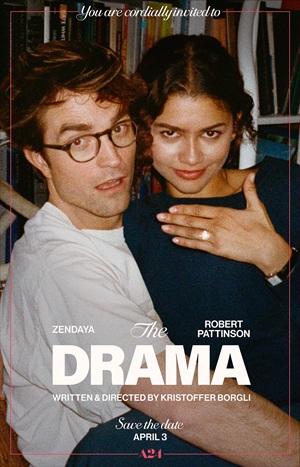
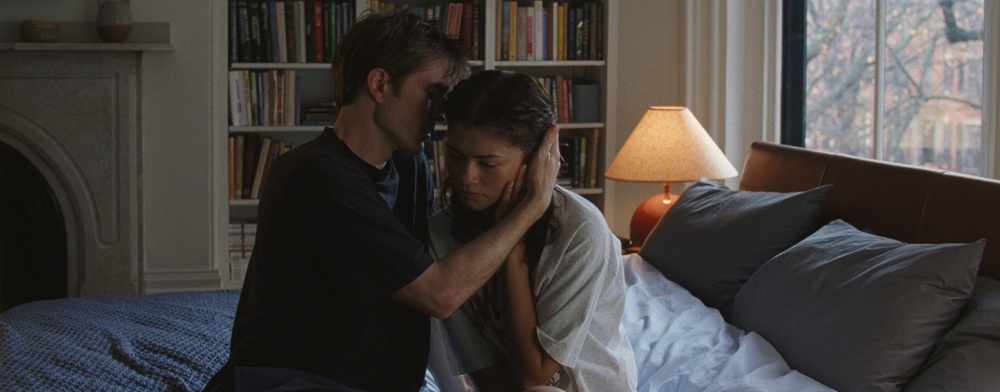
That’s the question put to Emma (Zendaya) and Charlie (Robert Pattinson) only days before their wedding, and it’s the former’s answer that has the latter reconsidering whether or not the person he fell in love with is who she appears to be. It also creates an unbreakable wall between the bride and her Maid of Honor, Rachel (Alana Haim), and prompts the Best Man, Mike (Mamoudou Athie), to openly wonder if the groom is making a mistake if he goes through with the ceremony as planned.
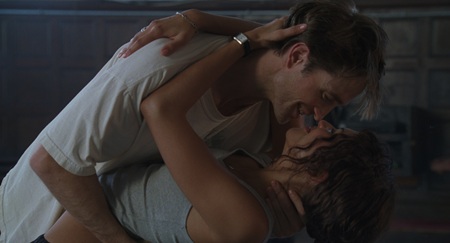
In other words, The Drama is not your standard marital farce romantic comedy. Much like with his previous features, Dream Scenario and Sick of Myself, writer-director Kristoffer Borgli has a lot on his mind. Also like those earlier endeavors, he’s not entirely successful in delivering on everything he wants to say. While the filmmaker makes several salient points, most of them are so unfinished that they fall frustratingly flat. While there’s plenty of food for thought, by the time this cinematic meal concluded, I still felt famished. Even worse, I was angry at Borgli for cooking up such a frustratingly unsatisfying banquet in the first place.
Granted, part of my unhappiness has little to do with the scenario itself and more to do with how the picture is being sold. There are several reasons why the marketing hasn’t been upfront about the secret Emma has been carrying since she was 15-years-old. It also makes sense that Borgli would want the audience to be as shocked by this revelation every bit as hard as Charlie, Rachel, and Mike are. It comes after their “bad deeds” are exposed, and it’s so extreme that, even though she never went through with her plans, once uttered aloud, it still can’t make their terrible transgressions pale in comparison.
However, there is also a cynical reason this has been saved as a jarring twist, and it has everything to do with the distributing studio likely being terrified audiences would stay away in droves if they knew what this story wanted to discuss. It’s a lot easier to create trailers, social media posts, and commercials for a charmingly goofy, Zendaya-Pattinson romcom than it is an upsetting, bleakly satirical examination of a uniquely American crisis involving youth, mental health, school bullying, and an individual’s all-too-easy access to items that could facilitate unspeakable mass tragedies.
Putting that aside, and returning to the idea that Emma never followed through on her plans but that the other three did in fact do damage — maybe lasting — to their victims during their teenage years, there’s a lot about this worth mulling. This is especially true as it pertains to Charlie and Rachel. Their actions were irredeemable, yet neither thinks about what transpired as more than a dark secret that shows how much they’ve progressed as supposedly decent human beings in the decade-plus since they took place.
But they don’t know (or can’t recollect) what happened to those individuals. Worse, they seem indifferent to this truth. In their opinions they have changed, and that is what is most important; whether or not their victims are still living with the ramifications of what was done to them back when they were kids is barely an afterthought.
Borgli doesn’t dwell on any of that. Only Emma’s actions, which directly led to her losing her hearing in one ear, are put under the microscope. Can a person who thinks about and even goes so far as to plan such a heinous act be redeemed? Or are they just a monster whose lethal camouflage will get pulled away at a later, unknown date? And, because of this, should they be forever condemned to walk in the shadows alone? Or would placing them there only lead to the very mass causality catastrophe that was mercifully avoided when Emma was back in high school?
It’s weighty material. To Borgli’s credit, the filmmaker does try to explore it with intelligence, empathy, and nuance. But there are so many missing pieces, nothing comfortably fits together. Ideas are considered, then dropped. The pitch-black humor only works in fits and starts, and while comedy and calamity do oftentimes walk hand-in-hand, the juxtaposition between the laughs and the trauma is decidedly uneasy. Bits that do work nicely, like an extended montage of Emma and Charlie trying to take pre-wedding test pictures with their acid-tongued photographer, indeed make an impact, many of the others felt forced and insincere. It’s as if they’ve been inserted into the proceedings with vulgar inelegance because Borgli doesn’t trust the audience to deal with all the complex issues he’s presenting on their own; he needs to soften the blow with an impromptu jolt of silliness.
I also found that I wanted to see more of this story through Emma’s eyes. There are blips, sudden frantic flashbacks from an untrustworthy narrator which show how hard she is trying to reconcile this moment from her youth with the person she has worked so hard to become as an adult. But the film never spends enough time analyzing any of this and instead pushes the young woman to the sidelines of a story that she should be at the center of. It minimizes her pain, making it play as a tertiary subplot to the primary narrative.
Not to say that Charlie’s journey isn’t important. It is. But his story is far less interesting than hers is. More, as already discussed, he once followed through on doing something unpardonable, so it’s not a question of whether or not he could do something similar in the future. Yet, even then, even when Charlie psychologically breaks and makes a massive workplace mistake, it’s as if it’s perfectly okay if he gets forgiven. It’s boys being boys, if you will. Nothing to see here. Move along. Move along.
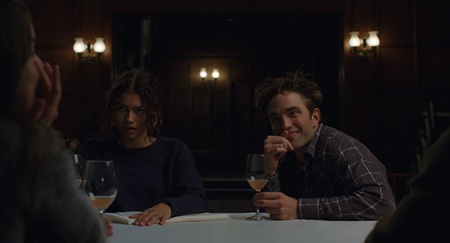
Through it all, Zendaya and Pattinson, their chemistry melting the screen, are superb, the latter in particular. The actor gives a volcanically towering performance full of physical dexterity, verbal anguish, and emotional subtlety. Pattinson masterfully navigates through a genre-jumping minefield that tasks him to reach Capraesque levels of melodramatic, teary-eyed excess while also exhibiting comedically farcical timing that’s on a similar plateau as what Peter Sellers effortlessly brought to Jacques Clouseau (The Pink Panther) or what Kevin Kline manically infused into Otto West (A Fish Called Wanda).
None of which allowed The Drama to fully resonate with me. There’s plenty to talk about as it pertains to Borgli’s latest, several fascinating ideas and difficult issues deserving of intense debate. But if the film isn’t an honest broker when it is examining them, if the filmmaker keeps undercutting or minimizing their own arguments long before they can clearly articulate what they’re supposed to be about in the first place, why do I need to do the heavy lifting for them? I don’t, and I don’t think the audience needs to do it, either.
Film Rating: 1½ (out of 4)