

Michael is Bad, So Bad, and It Knows It
The first album I ever bought with my own money was Michael Jackson’s Thriller. I must have played that sucker a few thousand times. Song after song was constantly blaring through our Spokane home. My mom would dance around the kitchen. By the end of the summer of 1982, even my dad, who was no fan of Jackson’s (or pop music in general), was starting to sing along to the lyrics from everything from “Billie Jean” to “Human Nature” to even “Wanna Be Startin’ Somethin’”.
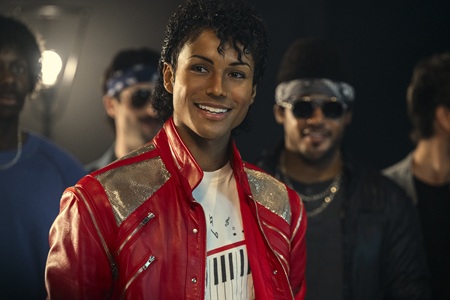
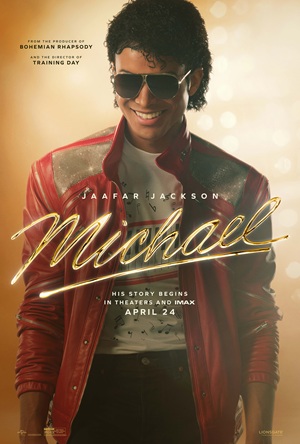
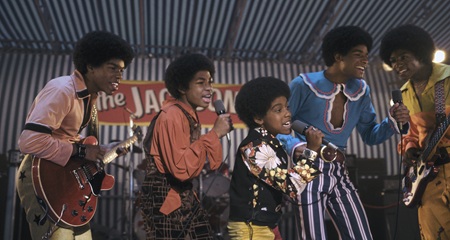
So, it pains me to state that the new musical biopic Michael is terrible. Not the music. It’s as extraordinary as ever. Not the most important performances. Jaafar Jackson (Michael Jackson’s nephew) is marvelous, balancing open-hearted, childlike innocence with a mournfully somber internalized pathos that can sometimes pack an unexpected wallop. Juliano Krue Valdi is even better as the young Michael, showcasing startlingly sincere emotional complexity that’s coupled with a mesmeric stage presence when performing as a member of The Jackson 5 that knocked my socks off.
But none of that makes the overall movie worthwhile. This is a torturous slog that never examines its central protagonist in meaningful detail. It’s a superficial, surface-level endeavor that comes across like some obscene greatest hits cover band version of the life and times of Michael Jackson instead of anything remotely substantive. The whole thing is a hagiographic nightmare that only works as well as it does because the music is so undeniably brilliant. But there’s no there, there. None.
Michael is bad, so bad. Worst of all, I think it knows it.
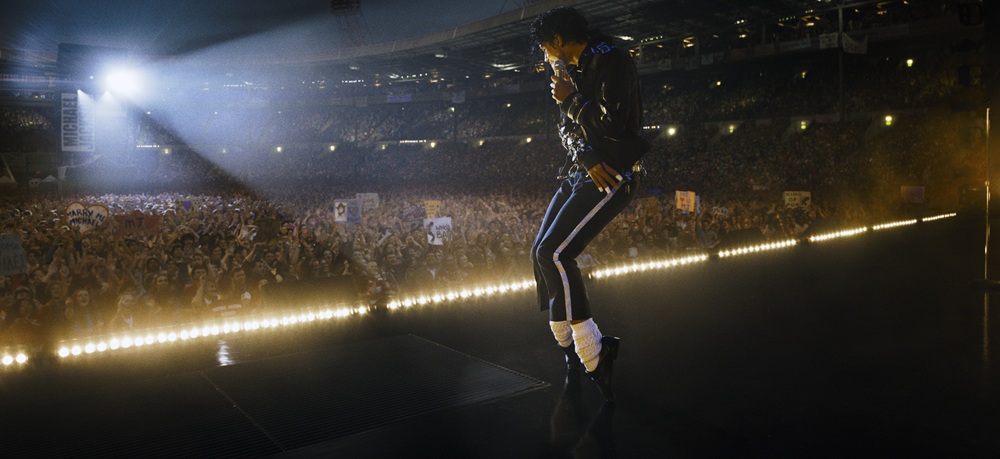
What’s particularly funny is that the film covers almost three decades of Jackson’s life (beginning with the birth of The Jackson 5 in Gary, Indiana, in the early 1960s, and culminating with a 1988 concert at London’s Wembley Stadium as part of the Bad World Tour), and yet that’s only half the story. While I never expected the film to dive too deeply (if at all) into the controversies that dogged the icon during the 1990s and 2000s, I was hoping there would be at least a modicum of complexity to how he was depicted, some small attempt to make him human and not a godlike musical deity who moonwalked across a stage and released the best-selling album of all time.
Maybe director Antoine Fuqua (Training Day, The Equalizer) and writer John Logan (Gladiator, The Aviator) were interested in doing that when they signed onto the project, but you’d never know that was the case based on the finished project. With the Jackson family having complete control, the producers who authorized the picture certainly had no intention of taking any chances or potentially courting controversy. Others are more conspicuous by their total absence, notably sisters Rebbie and Janet (the entire production acts like neither existed in the first place, let alone — in the case of the latter — released one of the most important albums of the late 1980s, Rhythm Nation 1814).
Look, I get that 2007’s Walk Hard: The Dewey Cox Story kind of ruined the straightforward, celebratory musical biopic, but that doesn’t mean these movies still can’t be enjoyable. Treat the audience with respect. Don’t be afraid of complex characters. Stage dynamic musical numbers. Grant insights into corners of the artist’s world that maybe viewers didn’t know much about beforehand. Stay away (when possible) from stereotypical moments of conflict (i.e., band breakups, drug abuse, shouting matches that turn into song creation; that sort of thing) unless you’re going to strip them down to their basic elements and not layer on the schmaltz, cheese, or melodrama.
Yet this motion picture misses the mark on multiple fronts. Family patriarch Joseph Jackson (a game Colman Domingo, doing his best to rise above cliché and hideously egregious latex makeup applications) is unsurprisingly painted as the villain, but he’s never around enough to feel like much more than a facile threat. Nia Long has so little to do as mother Katherine Jackson (other than repeatedly say variations of “I’m sorry” to Michael throughout the picture) that it’s hard not to wonder if the bulk of her performance was accidentally excised during editing. Like Rebbie and Janet, she might as well not even be here. Other recognizable actors like Miles Teller, Larenz Tate, Laura Harrier, and Mike Myers (who might as well be reprising his character from Bohemian Rhapsody, even though he’s not) fare even worse.
One does dismiss Michael entirely at one’s peril. Jaafar Jackson and Juliano Krue Valdi are indeed terrific as Michael Jackson, each deserving of a far better film considering the mesmeric enormity of their work. Depictions of certain signature moments, like the “Thriller” video shoot or the “Billie Jean” performance at the Motown 25: Yesterday, Today, Forever concert in 1983, are spectacular. As for hearing all of those incredible, toe-tapping songs in surround sound Dolby Atmos? There’s little better than that, and this audio perfection allows each concert recreation to feel vibrantly alive and infectiously joyous
But it isn’t enough. At least, not enough for me. Michael Jackson, flaws and all, deserves a much better examination of his life, family, music, career, and legacy than what is happening here. While I still know the lyrics to all of my favorite songs (and I’d bet my last dollar that my dad still knows them, too), I’m not going to let my continued affinity and adoration for those trick me into liking this disappointing flop of biographical rubbish.
– Review reprinted courtesy of the SGN in Seattle
Film Rating: 1½ (out of 4)