
Transformational Girls Like Girls Sings a Proud Song of Acceptance
The list of good films, let alone great ones, based on or inspired by memorable songs is a short one. Earth Girls Are Easy? Maybe. Alice’s Restaurant? I might give people that one. It’s quirky and weird. Love Potion No. 9? Absolutely not, and I’d be ashamed at any of you if it were to be brought up. Harper Valley P.T.A.? Great. Now I’m ashamed of myself for letting it be mentioned at all.

Seriously, though, it’s not a great group to be in. Sam Peckinpah’s 1978 trucker action-drama Convoy, with a suitably brooding Kris Kristofferson, might be the best I’ve seen, but it’s still hardly anywhere close to being the legendary director’s finest hour. The song-to-movie pipeline is a tough nut to crack.
But apparently not for actor-producer-singer-author-director Hayley Kiyoko. She’s taken her hit 2015 pop song Girls Like Girls (as well as its iconic story-based music video) and transformed it into one of the more strikingly intimate, empathetically sincere Lesbian coming of age stories in years. Her feature-length debut is a marvel of restrained storytelling, sterling outdoor cinematography, immersive sound design, and emotional authenticity. It also features the arrival of a major star in Maya da Costa, the actor delivering a performance of such poetic ebullience that I was in awe watching her make her way through Kiyoko’s enthralling 95-minute drama.
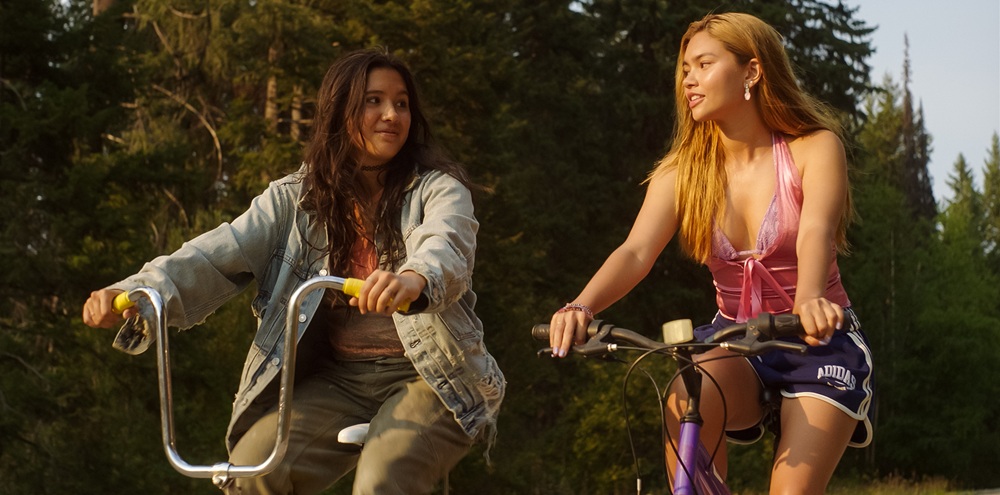
The setup is pure pulp YA melodrama. It’s 2006, and after the sudden death of her mother, 17-year-old Coley (da Costa) is transplanted to small-town Oregon with her father, Curtis (Zach Braff), a man she barely knows. It’s the early days of summer, right before her senior year of high school, and on an exploratory bicycle ride, the teen runs smackdab into dance prodigy Sasha (Myra Molloy) and her group of obnoxious friends.
After a bizarre event involving one of the boys at the local swimming pond hot spot, Coley thinks she’s done with this clique. But Sasha won’t have it. She goes out of her way to make Coley her friend. The pair sincerely enjoys spending time together. One thing leads to another, and soon, they’re wondering if there might be more than friendship between them. It’s possibly love.
The usual hardships follow. Trust gets broken, and secrets are revealed. Some of the boys try to exert dominance over the girls and force them back into accepted social constructs. Others make a valiant attempt at understanding and progressiveness. One girl is ready to announce to the world who she is, damn the consequences. The other feels the need to retreat back into the safety of heteronormativity and maybe disappear. There’s not much more to it.
But the same can be said about director Donna Deitch’s groundbreaking 1985 classic Desert Hearts. Two women meet under unusual circumstances, friendship leads to passion, which leads to love, which then leads to social conflict. It all builds to an ephemeral ending of understated restraint that’s as uplifting as it is heartrending, with everything played out in a secluded, windswept locale that’s as picturesque as the two leads cuddling in one another’s arms is.
The beauty of what Kiyoko accomplishes is how fresh, exciting, and current she makes this scenario feel. Even though the story takes place two decades ago, all of the ideas and themes are as current now as they ever were then, maybe more so. Youth culture advances faster than adults can keep up with, but parental and friend-based peer pressures are sometimes obstacles too gigantic to vault over without getting hurt (or hurting someone else). These are all elements Coley and Sasha must face if they ever want to imagine a scenario where they could end up together.
Kiyoko keeps things focused on Coley. This is her film, and I loved how her character, while hopelessly enamored with Sasha, and at a critical juncture, refuses to be defined by her. Coly is her own person with her own identity. She has agency. While the young woman may not always say or do the right thing, her heart remains pure no matter what obstacle she is working to conquer. Coley’s journey is breathtaking.
Young da Costa is a revelation. This is a superior performance. She inhabits Coley with primal urgency. Her rage and pain are entirely genuine, born from a place of unimaginable tragedy no youngster — no one at all — should ever have to face, let alone think they need to overcome alone. Da Costa elevates an already strong script (written by Kiyoko and Stefanie Scott and from a story the director co-wrote with Chloe Okuno) to a stratospheric plateau. Her physicality is only matched by her internalized intensity, and this makes her character as memorable as she is timeless.

Sasha’s evolution isn’t as equally well realized. Molloy is great, and I was fully captivated by her performance, but the film doesn’t spend nearly enough time with the teen to make her adolescent mood swings come off as authentic. Sasha can be quite cruel at times, and not in ways that could normally be easily forgiven. By the time catharsis and some modicum of forgiveness began to generate, I was worrying the girl wasn’t worth all of the fuss
But not for very long. Molloy and de Costa’s chemistry is undeniable, and it’s a treat to watch the two share the screen — even when the material may let them down somewhat. The film’s more melodramatic tendencies are softened considerably by Kiyoko’s keen eye and her attention to detail. A lesser director would drown the material in pop songs and syrupy montages, but she refuses. An entire elongated sequence with Coley and Sasha following a secluded railroad track and descending deeper into an Oregon forest (or, in this case, British Columbia subbing for Oregon) is a triumph of ambient sound design, stunning visuals (courtesy of cinematographer Sonja Tsypin), and superlative performances. It’s a scene that will stick with me for the rest of 2026.
And so we have it, our first feature film based on a hit pop song that’s actually better than the memorably catchy tune that inspired it. Girls Like Girls sings a story of transformation, understanding, heartbreak, and love worth singing along to. Not secretly sitting in the car. Not in the shower. But openly, loudly, proudly, and, most of all, in front of everyone.
– Review reprinted courtesy of the SGN in Seattle
Film Rating: 3½ (out of 4)