

Fennell’s Maximalist “Wuthering Heights” Eschews Brontë for Harlequin-Romance Sensationalism
It mystifies me why so many directors insist on transforming author Emily Brontë’s 1847 novel Wuthering Heights into a gothic love story. Most, including the absolute best of them (namely Andrea Arnold’s 2011, non-whitewashed take, which is my favorite, and William Wyler’s 1939 version, starring Laurence Olivier and Merle Oberon), only take on the first half of the tale and omit the second entirely. Even when I’ve liked the film, this has always annoyed me.
Enter Emerald Fennell. Give the talented writer-director credit for honesty, but by insisting on quotation marks around the title of her version of Brontë’s classic, it’s obvious she’s not even trying to fool viewers into thinking they’re watching a beat-for-beat adaptation. Her “Wuthering Heights” is like some crazed, hyperactive, colorfully masochistic music video interpretation, complete with pulse-pounding technopop interludes courtesy of superstar Charli XCX.
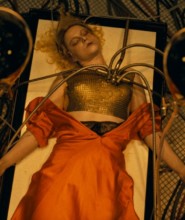
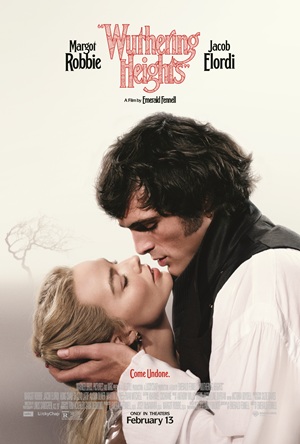
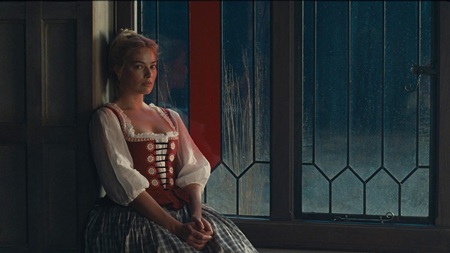
Almost everything about this production is gargantuan. The performances by Margot Robbie as the excitable Cathy, Jacob Elordi as the brooding Heathcliff, and especially a scene-stealing Alison Oliver as the childlike firebrand Isabella (who ends up having a fondness for sadomasochism, complete with barking like a dog at her lover’s feet). The sumptuous, doll-like costumes are crafted by Academy Award winner Jacqueline Durran (Little Women). The creatively bedeviling and provocative production design and art direction was dreamt up and brought to unforgettable life by Suzie Davies (Conclave) and Caroline Barclay (The Favourite). If there’s a textbook definition of “maximalist,” this motion picture would be it.
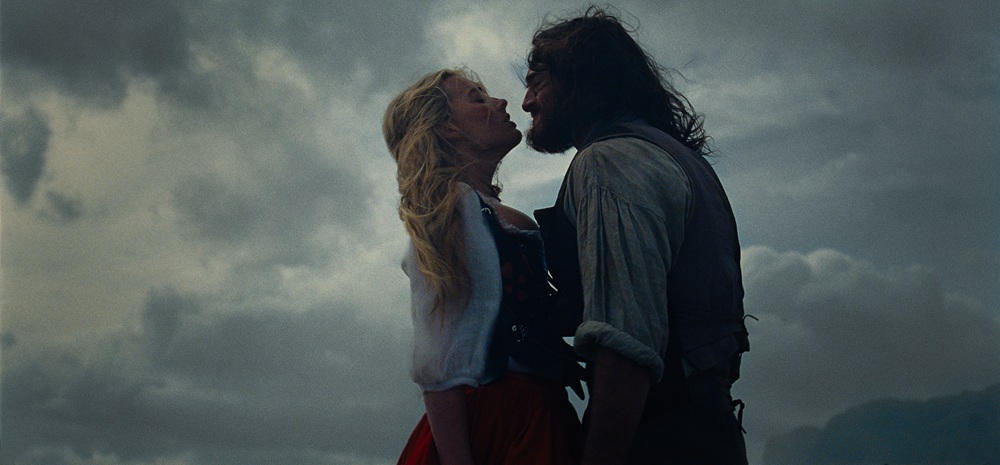
Fennell, seemingly inspired by fellow artists as dissimilar as Jean Cocteau, Alain Resnais, Stanely Kubrick, Ken Russell, Dario Argento, Francis Ford Coppola, and Sophia Coppola (just to name a scant few), fearlessly throws everything at the flesh-colored walls to see what sticks. The resulting madness is an eye-popping avalanche of amped-up emotions, wind-swept fields, muddy animal pens, sweaty brows, and Faustian bargaining. Brontë this isn’t, but it sure is incredible to look at.
However, unlike the director’s previous endeavors (Promising Young Woman and Saltburn), this trek into social, racial, and gender inequality (not to mention sexual deviancy and liberation) is never as radical as I felt was the intent. For all the naked canoodling along the seaside cliffs or on beds of straw in a dilapidated barn, there’s precious little heat generated by either Robbie (who is never believable as Cathy, despite her rambunctious abandon) or Elordi when they are together. The sex comes across more like something out of a Red Shoe Diaries installment than it is authentically passionate, and this makes the pair’s tragic affair maddeningly forgettable.
I will say this: Fennell does not shy away from the toxicity and cruelty that rule most of Heathcliff’s actions, especially toward Isabella. While the whitewashing of the character works against core aspects of Brontë’s prose, Elordi still gives it everything he has to stay true to the man’s angrily rebellious core. He showcases Heathcliff’s psychological devolution with raw, unhinged ferocity. It’s an aggressive take, and it would have been interesting to see what else the actor would have done with him had Fennell adapted the book’s second half.
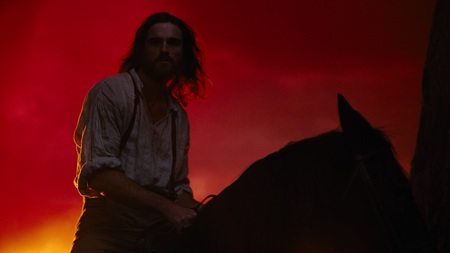
Even so, the filmmaker does allow this interpretation of Heathcliff to be a lethal examination of his blossoming, revenge-fueled bloodlust. But this only makes it more annoying that she timidly stays away from the climactic sections of Brontë’s work. Fennell spends so much time painting pretty portraits of bursting bodices, orgiastic experimentation, voyeuristic secrecy, and even 19th-century pony play that any larger explorations go nowhere valuable. It’s a strange hodgepodge of gorgeous imagery and vapid sensationalism, a combination that left me more frustrated and perplexed than anything.
Fennell’s “Wuthering Heights” isn’t Brontë, and it’s clear it isn’t meant to be. It’s opulent, flamboyant, and made with confident, freewheeling precision by a talented filmmaker who enjoys flaunting her singular voice. But none of that means the resulting film is any good. Interesting? Yes. But good? No, and if Cathy and Heathcliff’s relationship is the stuff of epic tragedy, then that this incarnation registers as nothing more than a second-rate Harlequin romance might be an even bigger one.
– Review reprinted courtesy of the SGN in Seattle
Film Rating: 2 (out of 4)