Mother Mary: Music, Myth, Hate, Passion, and the Freeing Supernatural Release of an Honest Conversation
“This is not a ghost story.”
So proclaims Mother Mary, the new film from A Ghost Story, Pete’s Dragon, and The Green Knight filmmaker David Lowery. But ghosts do play a part. Ghosts of the past. Ghosts of the present. And, to complete the Dickensian trifecta, ghosts of an unwritten future.
“This is not a love story.”
Another declaration, also accompanied by several caveats. International pop star Mother Mary (Anne Hathaway) and world-renowned British fashion designer Sam Anselm (Michaela Coel) do share a complicated past. For over two decades, they were joined at the hip: The former a musician destined for superstardom; the latter her innovative costume designer who created the singer’s signature darkly angelic persona. Their friendship was deep, passionate, and all-encompassing, and while romantic entanglement between the two may or may not have materialized (that’s none of our business), if the almost symbiotic intimacy they did share wasn’t born from love, it’s difficult to fathom what other emotional intercourse could have given birth to it.
Mary and Sam’s reunion comes at a moment of internalized crisis for both women. The singer is days away from a comeback performance that will likely determine if she is physically and mentally capable of continuing her career. As for the designer, she is putting the finishing touches on her latest collection and is resigned to the belief that her latest haute couture fashions are far from her best, most innovative work.
Thus appears Mary on Sam’s doorstep, pleading for her to design a new dress, practically overnight. That’s the story. This is the tale that Lowery is compelled to explore.
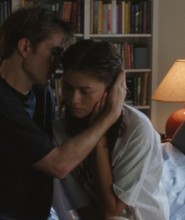
Or is it? What follows on from that simple setup is a supernaturally metaphorical tête-à-tête between two complex women with a difficult past, unhurriedly dancing around one another as they try to figure out why fate has brought them back together. Sam needs to know why Mary needs her, and only her, to design this dress. Mary needs Sam to, if not forgive her for leaving all those years prior, to at least understand why she felt it was necessary to do so.
Truth, lies, the stories and fantasies we sometimes tell ourselves to get through the day, all of that and more is explored as these talented iconoclasts reveal their deepest, darkest, and most fervently concealed secrets to one another. While the scars they carry are far from new, the blood dripping from them messily onto the wooden floor of Sam’s personal workroom (a massive barn that could easily double for a rustic house of worship) undeniably is. None of what happens is intended to be a metaphor, yet practically everything they say and reveal has an allegorical element that cannot — should not — be denied.
It’s all exactly as Lowery intends it to be, and it’s impossible to say on a single viewing that every facet of this tale works as he likely intends it to. This is the type of creative effort that, like a great pop song, deserves revisiting. Each layer, every image, each lyric or musical cue, they all lead to multiple readings of what is going on and why. The driving force behind every word Mary and Sam utter is a poem where the meaning shifts depending on the state of mind of each individual member of the audience. The viewer becomes part of the overall presentation.
Hathaway and Coel are revelatory. Each gives a performance for the ages. They meticulously orbit around one another, at times like serpents closing in on their prey, while at others like mice searching for an escape route to avoid a feline adversary waiting for the perfect opportunity to pounce. Each actor makes a hearty meal of Lowery’s lyrical dialogue. Yet, they also have the wherewithal to become a fully transfixed silent observer when it’s the other’s turn to speak whatever it is they are compelled to say. Neither, to my mind, has ever been better, Coel in particular.
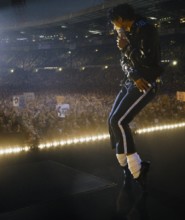
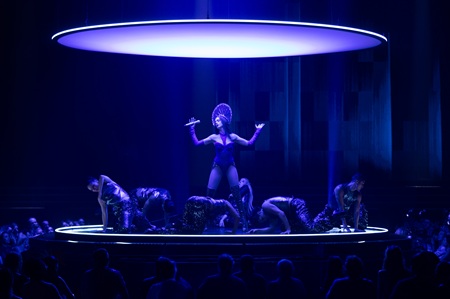
The concert sequences are like something out of a phantasmagorical hallucination. Hathaway owns the stage, the score from composer Daniel Hart (Ain’t Them Bodies Saints) ebbs and flows like the tide crashing against a rocky shore, while the intricate songs written by Charli xcx, Jack Antonoff, and FKA twigs (who also has a small, pivotal role as a character who inadvertently helps lead Mary back to Sam) are marvelous. Director of photography Andrew Droz Palermo (Thunderbolts*) has his camera slowly slink this way and that with fastidious resolve, his containing an audacious and haunting urgency that frequently stopped my breath cold.
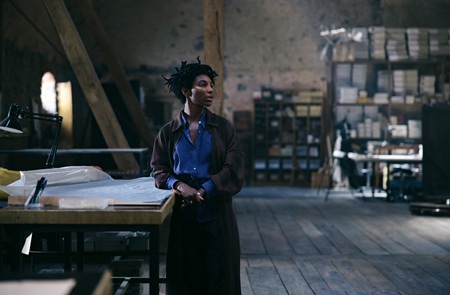
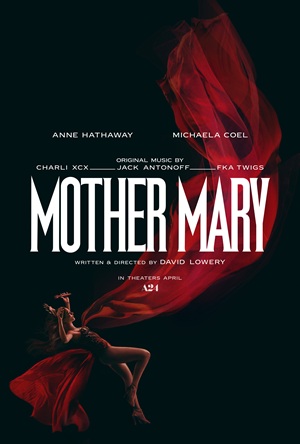
Then there is the Red Dress. To say too much about it would be a spoiler. To also admit it struck an unexpected nerve deep inside of me from its first ominous appearance to its last elegant presentation is equally essential. It drives the painful, almost mournful fury lurking at the heart of Lowery’s narrative. It is the beast that reawakens to passionate, sensually ravenous yearning Mary and Sam still share. This dress is the key to unlocking the central mystery that keeps both women awake at night. It is also the totem that allows the audience to enter seamlessly into their world as if they’ve been a part of it from the very beginning.
Not a ghost story. Not a love story. Maybe that’s true. Maybe it’s not. What is accurate is to say that Mother Mary is an impressively labyrinthine sojourn into creation, art, music, and interpersonal connection that eschew gender, sexuality, and societal norms to become something else entirely. Something new. Something mythic. Something almost certain to last forever.
– Review reprinted courtesy of the SGN in Seattle
Film Rating: 3½ (out of 4)