

Unintentionally Hilarious Mercy is a Cautionary A.I. Misfire
Set in 2029 in a crime-ridden Los Angeles that looks more like something out of John Carpenter’s Escape from L.A. than it does a realistic depiction of near-future chaos, the new cyber-thriller Mercy may go down as one of this year’s funniest films. Granted, it’s not a comedy. Instead, this is a real-time murder mystery about a determined detective put on trial for the murder of his wife, facing an artificial intelligence judge who will execute him if he can’t bring his probable percentage of guilt down to a level where reasonable doubt would come into play.

Directed by Timur Bekmambetov (Night Watch, Abraham Lincoln: Vampire Hunter) and written by Marco van Belle, this visually repugnant, structurally inept Searching meets Her meets a random episode of a ho-hum television police procedural (something in-between a NCIS spinoff and a CSI spinoff) wasn’t for me. Stars Chris Pratt and Rebecca Ferguson alternate between overplaying their performances like they’re about to get booed off the stage of their local high school or lifelessly phoning it in so they can snag a quick and easy paycheck. The whole project is so aggressively annoying that all 100 minutes of it felt like some cruel endurance test. To put it simply, this one isn’t very good.
But here’s the rub: There are moments, especially during the ludicrously hyperactive climax, that are flat-out hysterical. Lines of dialogue. Tonal shifts. Absurdly staged action beats. Overbearing snippets of Herculean-level unrestrained melodrama. It’s all here, and nearly every bit of it had me chortling so hard I had to wipe away a handful of tears. The whole thing becomes so gloriously stupid that it could almost be construed as entertaining. For all the wrong reasons, of course, but nonetheless still fun to watch.
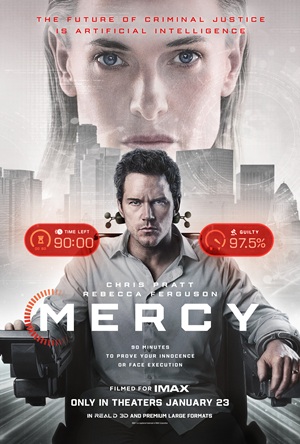
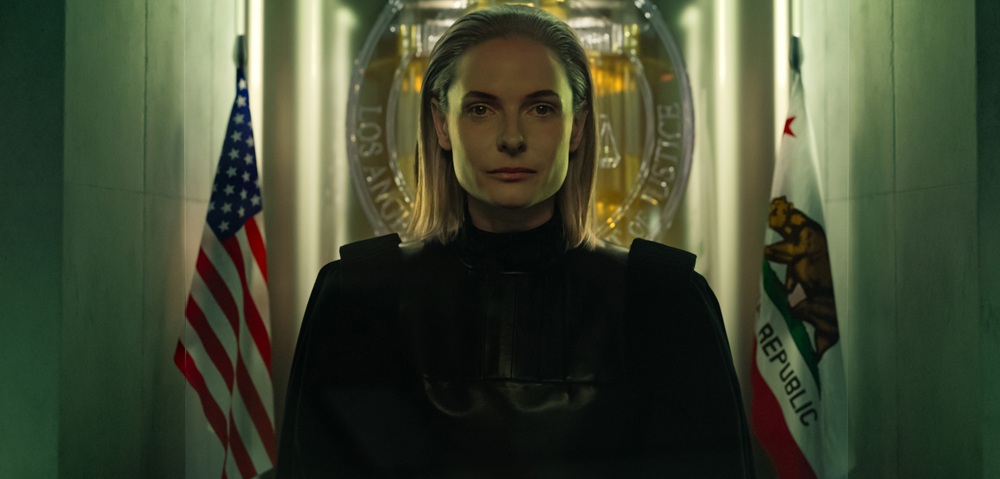
Pratt is Detective Chris Raven, a veteran officer who helped establish the Los Angeles “Mercy Court,” a courtroom under the control of an A.I. judge (Ferguson), where the worst defendants go on trial and have only 90 minutes to convince this cybernetic entity that they deserve a jury trial. If they don’t? Then they are immediately executed. No appeal. No chance for review. Everything handled then and there, and all of it completely automated with zero human interference.
Raven wakes up with a brain-numbing hangover to find himself strapped to a chair inside the Mercy Court and on trial for the murder of his wife (Annabelle Wallis). With every electronic surveillance, computing, and communication device in L.A. at his disposal, he has to bring his guilt probability down from 98% to 92%. If he doesn’t succeed, he will be humanely put down like a feral dog. During the process of defending himself, he uncovers a vast conspiracy that could rock the city’s foundations to its core. At the same time, he also causes the A.I. overseeing his case to reconsider whether or not complete human noninvolvement is as fair and as humane as it is purported to be.
While not necessarily an original idea, the scenario as presented in Mercy isn’t without potential. But the filmmakers seem resolutely determined to waste every ounce of it, twisting the plot in knots for no real reason other than maybe they think chaos for chaos’s sake is enjoyable.
It’s not. Bekmambetov overflows the frame with varying aspect ratios, three-dimensional images, forced perspectives, and so much needless second- (and third, and fourth, and fifth, and so on, and so forth) screen stuff that it all becomes nothing more than headache-inducing ocular noise. I found it all obnoxious.
The characterizations are equally frustrating. Pratt, handcuffed to a chair for the majority of the running time, alternates between screaming and shouting his lines to suddenly muttering them in hushed, withdrawn cadences that barely register. As for Ferguson, she’s all stiff-upper-lip mechanized stoicism, and even when her A.I. veneer cracks, the actor’s performance stays so rigidly unappealing that the overall monotone banality of what she is doing oddly becomes somewhat impressive (which should not be construed as a backhanded compliment).

In fairness, Kali Reis does have a few solid moments as Raven’s partner Detective Jacqueline ‘JAQ’ Diallo, and it’s clear that the True Detective and Catch the Fair One star is far more invested in the material than it remotely deserves. But the rest of the supporting cast is criminally wasted, and that includes Emmy-winning character actor Chris Sullivan, and how he managed to deliver some of his lines without bursting out into uncontrollable laughter is beyond comprehension.
Ultimately, Mercy doesn’t even have the strength of its own supposed convictions or the wherewithal to play its scenario out to its logical conclusion. Instead, it hems and haws about the value of A.I., especially as it concerns law enforcement, and decides that taking no stand at all on this question is even more heroic than trying to make a definitive pro or con case on one side or the other. What’s clearly designed as a cautionary tale instead comes across as a boringly insincere copout, and that’s unforgivable.
At least it’s funny. I do have to give Mercy that.
Film Rating: 1 (out of 4)