Godzilla Minus Zero (2026) 
by Sara Michelle Fetters - November 6th, 2026 - Four-Star Corner Movie Reviews
Yamazaki’s Minus Zero brings Toho’s Godzilla Back to Life, and He’s Better than Ever
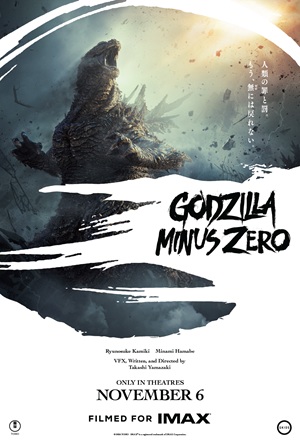
I won’t say Academy Award winner Takashi Yamazaki has, with Godzilla Minus Zero, made a better picture than 2023’s superb Godzilla Minus One. I am tempted to state that he’s equaled it. Bigger. Bolder. More narratively dense while also doubling down on the stinging anti-war and anti-military-industrial complex themes of its predecessor, this sequel is as thrilling as it is heartrending. Yamazaki pulls out all the stops, once again showcasing the legendary, unstoppable king of the monsters in ways that, even after 72 years of big-screen success, feel imaginative, refreshing, and, best of all, new.
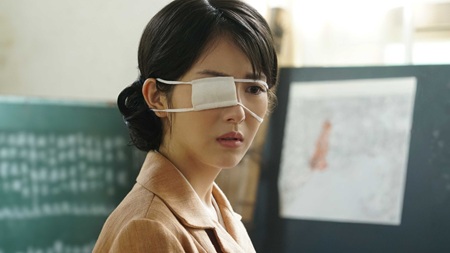
It’s now 1949, and after successfully leading the fight against Godzilla, Kenji Noda (Hidetaka Yoshioka) is now in charge of Japan’s Special Disaster Response Bureau (SDRB). After a particularly monstrous assault leaves a city in rubble, Noda turns to close friend Kôichi Shikishima (Ryûnosuke Kamiki) to help him train a new generation of pilots to fight gigantic reptilian adversaries. This doesn’t please Noriko (Minami Hamabe). Still suffering from the mysterious aftereffects of her close call with Godzilla two years prior, she doesn’t want to see their daughter, Akiko (Sae Nagatani), left an orphan. The child, like so many others in Japan, has already suffered far too much during this post-WWII and post-Godzilla reconstruction.
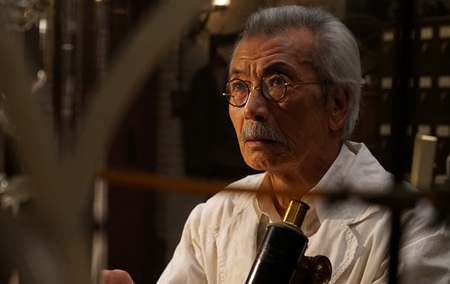
Yamazaki crafts a wide-ranging narrative that goes in roughly four or five different directions before effectively bringing all the pieces back together for the film’s stupendous, full-throttle climax. New characters include a brilliant meteorologist, Makoto Aoyama (Masami Nagasawa), and a revered scientist, Professor Kanji Murakami (Min Tanaka). Both have very personal reasons to aid Noda and the SDRB in their battle against kaiju. And, of course, you can’t have a Godzilla installment without the big guy himself, and his eventual resurrection is well worth the wait.
However, unlike Godzilla Minus One, Yamazaki doesn’t maintain firm control of all of his narrative convolutions. This is an expansive adventure that can’t always keep track of all its characters, and some of the more interesting plot twists aren’t nearly as well developed as I would have liked. The geographical playing field for the various encounters isn’t always clearly defined, and the build-up to the climactic confrontation relies on a great deal of coincidence for all parties to be brought together on the same battleground for their winner-take-all face-off.
Not that I cared. Yamazaki choreographs fight sequences, aerial encounters, and pugnacious battle royales between evenly matched titans with brutal, mesmerizing efficiency. An opening bit with Prof. Murakami barely making it out of a devastated city alive after a kaiju close encounter is masterfully staged, while a later set piece involving Shikishima leading a small group of pilots up against an electrifying, high-flying opponent is easily one of 2026’s most extraordinary action sequences.
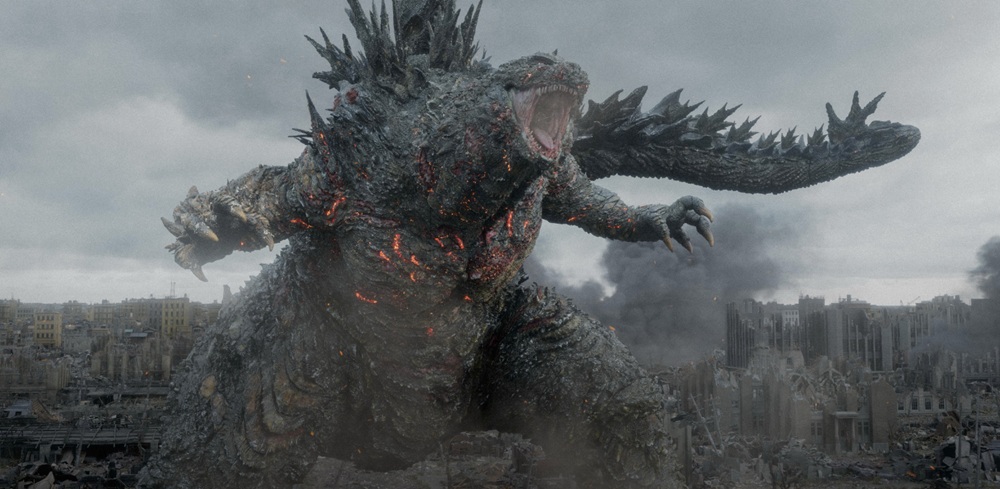
And then there is the last act. It’s sensational. I never knew I needed an extreme close-up of Godzilla’s eyes, full of rage and ready to unleash carnage, in oversized IMAX glory, but this ended up being one of the most blissfully operatic celluloid images I’ve frankly ever had the pleasure to witness. The audience audibly gasped, and it only gets better from there.
There has never been an encounter between titanic creatures that’s as perfectly staged as this one. Trying to keep it somewhat vague as to whom Godzilla is fighting (although, anyone even passingly familiar with series lore and who heard a particularly sound effect in the film’s trailer will already know this terrifying kaiju’s identity), this fierce throwdown amidst the ruins of an already destroyed city is an outright stunner. Each of the participants in this fracas showcases their destructive powers with nasty, eye-popping determination. Yamazaki, once again also working as his own special effects designer, has a painterly eye for detail. Calling this climax magnificent substantially undersells the enormity of the filmmaker’s achievement.
But, much like its predecessor, what makes this sequel essential is the emphasis on the human elements. By returning Godzilla to the post-WWII setting of his 1954 cinematic birth, Yamazaki is able to analyze themes relating to the state of the world, the military-industrial complex, and humanity’s continued insistence on destroying itself with prescient exactitude. Noda’s journey is haunting in its tragic inevitability, his selfless empathy in the face of making morally questionable decisions that affect not just Japan but the entire world, something special. Prof. Murakami’s character arc is also fascinatingly multifaceted, but as I don’t want to spoil anything, I’ll just say that Tanaka delivers one of the year’s best supporting performances and leave it at that.
Then there are the obstacles facing the Shikishima family. The two parents are never certain they are doing the right thing. They understand that every choice they make risks leaving Akiko another war orphan in a country already having difficulty properly caring for the ones it already has. But they are at the center of the conflict whether they want to be or not, each tussling with the reality that inaction will likely result in thousands, potentially millions, of Japanese deaths unless they are willing to potentially sacrifice themselves for a supposed “greater good.”
There’s plenty more to love, not least of which are Kôzô Shibasaki’s wonderful cinematography, Ryûji Miyajima’s crackerjack editing, and Anri Jôjô’s immaculate production design, all three returnees from Godzilla Minus One. Also back, and at the absolute top of his creative game, is composer Naoki Satô, his signature compositions intermixed seamlessly with Akira Ifukube’s iconic themes from Godzilla’s Shōwa era. There were moments here where the music had me fully levitating out of my theater seat.
As much as I tend to love all iterations of Godzilla, Yamazaki’s take on Toho’s most recognizable character remains phenomenal. No filmmaker has balanced unfathomable levels of kaiju devastation with important humanistic questions of war, grief, violence, government indifference, and societal self-annihilation within this universe as well as he has since the early days when Ishirō Honda was at the helm. Godzilla Minus Zero roars to life with a perceptive ferocity not soon to be forgotten.
– Review reprinted courtesy of the SGN in Seattle
Film Rating: 4 (out of 4)