

Talented Cast Can’t Keep Pitch-Black Satire How to Make a Killing from Being Dead on Arrival
If one wanted a case study on how far a charming ensemble can carry an otherwise mediocre motion picture, writer-director John Patton Ford’s How to Make a Killing would be a terrific place to start. Starring Glen Powell and showcasing a sensational supporting cast led by Bill Camp, Jessica Henwick, Ed Harris, Zach Woods, Topher Grace, and a flawless Margaret Qualley (whose fabulous femme fatale steals the film), every actor makes the absolute most of every last second of their screentime. More than that, they make it look easy.

Indebted to classic Ealing Studios endeavors of the 1950s (most notably a pair of Alec Guinness favorites, Kind Hearts and Coronets and The Ladykillers), and owing at least a small debt to 1988’s A Fish Called Wanda and 2019 Best Picture winner Parasite, even with a stellar cast, it all still falls frustratingly flat. Fresh off the success of his spellbinding 2022 sensation Emily the Criminal, the director explains when he should show, and all traces of wit or subtlety have been wrung out of this thing like a hand-washed towel draped over a clothes line.
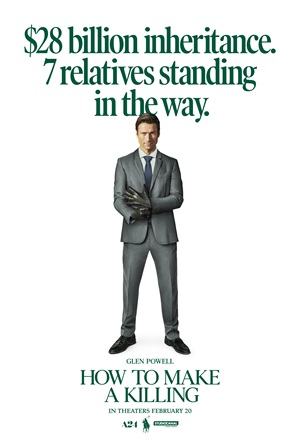
In basic eat-the-rich, pitch-black comedy fashion, events are centered on Becket Redfellow (Powell), an orphan who promised his mother (Nell Williams) on her deathbed to do whatever was necessary to get a piece of the massive $28 billion inheritance that should have been his birthright. But when the silver-spoon, high-society princess got pregnant by the wrong sort of man, his grandfather Whitelaw (Harris) had her disowned, callously sending her into blue-collar exile with zero chance of reconciliation.
Normally, this would mean Becket shouldn’t get a cent of the family fortune. But for tax purposes, Whitelaw refused to change his will. Upon his death, the entire lump sum goes to his closest living relative. Everyone else is cut completely off and receives nothing. With six others in front of him, and considering his grandfather shows no intention of dying any time soon, the only way Becket would ever see any of that money is if all the Redfellows met with untimely accidents, and wouldn’t you know it, he’s just the one who can give karma a not-so-gentle homicidal push.
Told almost entirely in flashback, Powell is at his good-natured best, chatting with a shellshocked priest about all of the dastardly deeds he’s been a part of. This allows Ford the chance to showcase each killing, the picture devoting longer stretches to some of the more interesting victims (primarily the ones portrayed by Woods and Grace), while also emphasizing the moral conundrums Becket ponders as he proceeds on his cutthroat quest.
In perfect film noir Out of the Past fashion, the dashing predator with a captivating smile is torn between two women. The angel on Becket’s shoulder is Ruth (Henwick), a kindhearted innocent who makes him reconsider his entire plan. The devil perched on his other one is Julia (Qualley), a childhood acquaintance who has grown up to be a seductive vamp who gets everything she wants and refuses to take “no” for an answer. Both actors are outstanding, especially Qualley. Between her work in Drive-Away Dolls, The Substance, Blue Moon, and now this, if anyone ever makes a Barbara Stanwyck biopic, they should cast her as the lead.
But much like a crackerjack professional sports team that looks great on paper yet fails to make a winning impression out on the playing field, How to Make a Killing never finds solid footing. It’s like paint-by-numbers satire, Ford spending so much time on exposition that the audience never gets the opportunity to put any of the puzzle pieces together for themselves. Everything is overexplained, little is left to the imagination, and even less makes a lasting impression.
It all looks great, as the technical facets (most notably the editing, costumes, and production design) are outstanding across the board. The snazzy score from Oscar-nominated composer Emile Mosseri (Minari) is particularly impressive, as are the confidently immersive, slickly colorful visuals composed by cinematographer Todd Banhazl (Hustlers). There’s also this brief, wonderful little moment from Camp where his character, a Redfellow family member who treats Becket like an adopted son, sits in a hospital room and delivers some melancholic life lessons with hushed gravitas. It’s absolutely lovely.

If only the remainder of this one matched this sequence or was worthy of the quality performances delivered by the talented ensemble. Funny in only fits and starts, everything trudges along on a path to a preordained nihilistic finale that’s nowhere near as bleakly amusing or as catastrophically hard-hitting as it is undeniably intended to be. It’s as if Ford is going for an ending similar to Charles Chaplin’s malevolent 1947 spellbinder, Monsieur Verdoux, but for whatever reason can’t pull it off. I found it all terribly disappointing.
Still, Powell, Qualley, and the rest of the cast give it their best shot, and as a showcase for each and every one of them, How to Make a Killing certainly shows flashes of the entertaining amoral goodness that might have been. But none of this is enough to overcome the tiresome banality of the half-baked and laborious social commentary. On that front, Ford’s latest is dead on arrival, and that’s too bad.
Film Rating: 2 (out of 4)