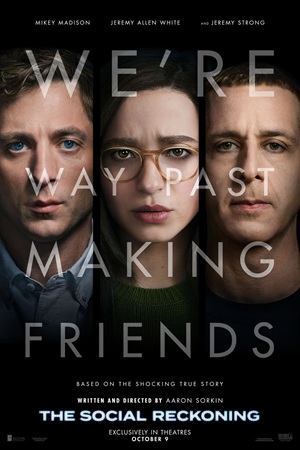


Sorkin’s Zuckerberg Takedown The Social Reckoning is a Vexing Mixed Bag
Writer Aaron Sorkin should stop trying to direct his own scripts. His ticking-clock procedural The Social Reckoning makes so many egregious missteps that watching it to completion can be a chore. But star Mikey Madison gives one of the best performances of 2026. I couldn’t take my eyes off of her. She’s dazzling. Because of all of that and more, this sequel to The Social Network is one of the more obnoxiously vexing films I’ve seen this year. It’s the very definition of a mixed bag.

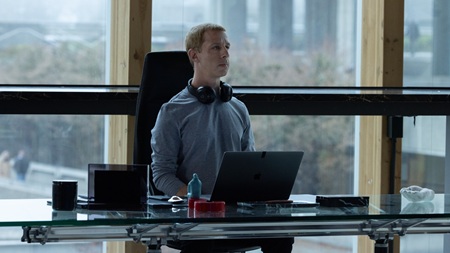
The plot follows Facebook data scientist Frances Haugen (Madison) as she turns whistleblower for The Wall Street Journal investigative reporter Jeff Horowitz (Jeremy Allen White) between 2019 and 2020. The pair’s interactions are juxtaposed with an irritated Mark Zuckerberg (Jeremy Strong) as he preps to testify before Congress about his company’s activities early in 2021. The half concerning Haugen and Horowitz works rather well. The remainder featuring Zuckerberg arguing with his team and getting angry at journalist Charlie Garrigan (Bill Burr) is forced, didactic, and emotionally empty.
It’s basically an All the President’s Men clone haphazardly conjoined to Sorkin’s 2017 judicial gambling thriller Molly’s Game, and as clever a writer as he might be, the filmmaker doesn’t have the directorial chops to mesh either of his narrative pieces cohesively together into a finished product. Additionally, much like with The Trial of the Chicago 7 and Being the Ricardos, there’s no one around to keep Sorkin from giving in to his more melodramatic, mansplaining instincts. There are moments of mind-numbing sexism that come out of nowhere, and — especially during the Zuckerberg sections — the director gets so infatuated with his own dialogue that he lets characters word vomit to the point that their scenes become unintentionally laughable.
Then there are the moments that defy any simple or straightforward categorization, scenes of such absurdly solemn earnestness that they can’t help but come off as a combination of silly, insulting, and offensive all at once. Sequences like this aren’t new to Sorkin, but in much of his television work, or with the previous films where he penned the script, there were directors who knew how to mitigate, soften, or even completely excise this sort of nonsense. Not always, of course, but enough that these moments didn’t stand out like a sore thumb.
Not here. In a scene that rivals episode seven of Sorkin’s The Newsroom (where an insufferable Don Keefer reveals to the flight crew of a grounded airplane that the U.S. military has killed Osama bin Laden), you’ll never guess which day in January 2021 Zuckerberg is doing his Congressional testimony run-through on. It’s a mind-bogglingly shallow and facile way to examine what transpired during the insurrection. This presentation is made even worse as it appears Sorkin puts these scenes in his film to produce a visceral reaction from the audience and not because he has anything substantive to say about what happened on January 6. It’s already clear by this point that Zuckerberg is a narcissistic sociopath, so the filmmaker’s inability, or maybe even outright refusal, to try and dig any deeper into his psychology as violence and chaos at Congress play on computer and television screens in the background is borderline unforgivable.
It’s bad. No argument there. But, like so many Sorkin endeavors, the good stuff is so very, very good it somehow manages to make the noxious elements seem kind of okay. In this instance, this is due almost entirely to the presence and the performance of Madison. Proving her Academy Award for Anora wasn’t a fluke, her work as Haugen is masterful. This is a jittery yet supremely confident portrait of an intelligent young woman fighting an internal war. The data scientist is a Facebook true believer. Yet when Zuckerberg changes the rules of the game, when he seems to be intentionally using his social media service to actively hurt people to make a profit and increase his own political power, Haugen can no longer remain silent.
Madison makes eloquent, intimately affecting music out of Sorkin’s material. She delivers his dialogue with the pitter-patter precision of Rosalind Russell in His Girl Friday or Katharine Hepburn in The Philadelphia Story. Her interactions with White sizzle with intellectual urgency, and even if the overt theatricality of their conversations doesn’t always seem genuine, the emotions that form their foundational base happily are. Madison is dynamite, and watching how she evolves Haugen from being a skittishly introverted Deep Throat into a definitely outspoken advocate for the truth is spectacular.
It’s hard not to watch all of this and wonder what David Fincher, who made The Social Network an Oscar-winning juggernaut, or the late Rob Reiner, who guided The American President to electoral success, would have made with this sequel. Sorkin has the pieces in place, and thanks to Haugen and Horowitz (their books The Power of One and Broken Code heavily influence the screenplay), the story he’s chosen to tell is undeniably pertinent.
Yet it’s all so frustratingly uneven that I’m still reticent to give a passionate endorsement of the finished product. I will recommend The Social Reckoning, though, mainly because Madison blew my socks off and also due to the half of the film that involves Haugen and Horowitz going all Woodward and Bernstein on Zuckerberg worked for me. But Sorkin’s Facebook diatribe is all over the map, and the more I keep thinking about it, the more I’m second-guessing hitting that “like” button. Maybe I should have gone with the “woman shrugging” emoji instead?
– Review reprinted courtesy of the SGN in Seattle
Film Rating: 2½ (out of 4)