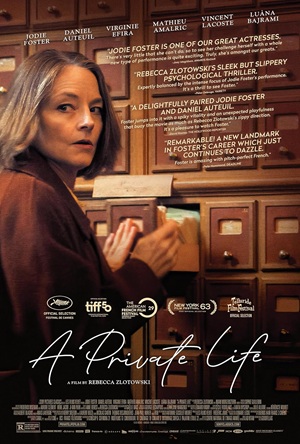

Jodie Foster and Daniel Auteuil Define Charismatic Movie Star “Perfection” with A Private Life
There’s something about watching two great actors in flawless synchronicity bouncing off one another with vivacious, freewheeling enthusiasm. Think William Powell and Myrna Loy in The Thin Man, Cary Grant and Rosalind Russell in His Girl Friday, Helen Shaver and Patricia Charbonneau in Desert Hearts, Billy Crystal and Meg Ryan in When Harry Met Sally, or Jake Gyllenhaal and Heath Ledger in Brokeback Mountain to get an idea of what I’m talking about.

While not rising to the stratospheric heights of those motion pictures, thanks to the charismatic, anything-goes star wattage of Jodie Foster and Daniel Auteuil, the jovial and lively French drama A Private Life makes a striking impression. The two superstars are magical, bringing depth, complexity, pathos, romance, and most of all joy to director Rebecca Zlotowski’s sensationally entertaining was-there-or-was-there-not-a-murder? murder mystery. They’re delightful.
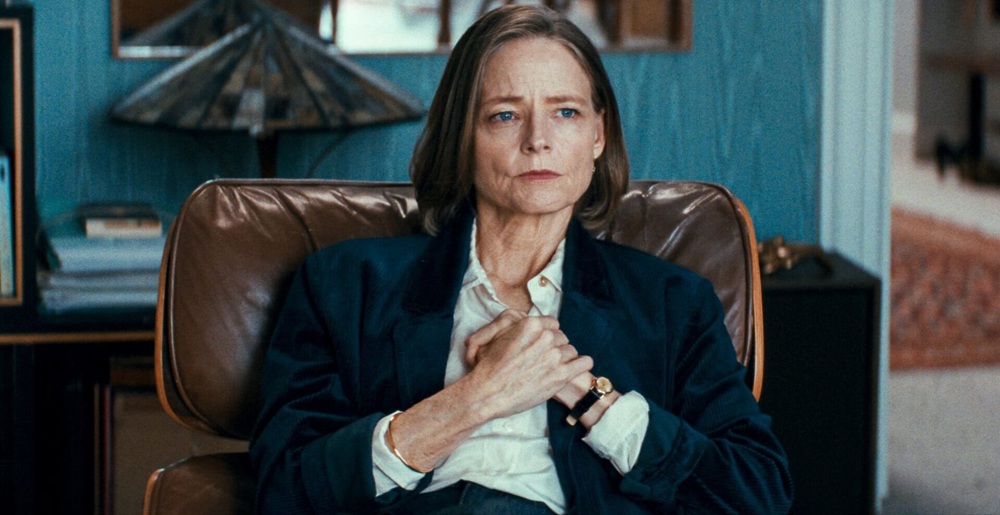
Lilian Steiner (Foster) is an esteemed psychiatrist whose bedside manner is anything but comforting. She’s stern and unfeelingly direct with her patients, and while she says she has their best interests at heart, truth be told, she’s been going through the motions for some time now. Lilian has seemingly lost her resolve to make a difference in the lives of others, so even when a longtime client suddenly breaks off their sessions (after claiming to have been “cured” of his smoking habit courtesy of a mysterious hypnotist), her first thought is of the lost income and not their well-being.
Then comes the sudden passing of Paula Cohen-Solal (Virginie Efira), apparently by suicide, and by overdosing on a medication Lilian had prescribed. After a visit from the woman’s inquisitive daughter, Valérie (Luàna Bajrami), the youngster claiming that her mother’s death was not by her own hand, the typically taciturn and hardhearted psychiatrist is oddly shaken. She comes to believe Paula’s husband, Simon (Mathieu Amalric), may have had a hand in facilitating his wife’s demise. Lilian is determined to prove this was indeed the case, even if she has to transform herself into a clumsy amateur detective to do it.
Auteuil enters the proceedings as Lilian’s ex-husband and renowned eye surgeon Dr. Gabriel Haddad. The pair reunite when the former shows up at the latter’s office for an impromptu eye exam. From there, the suspicious events surrounding Paula’s death come spilling out. After a couple of dinners (and even a little hanky-panky), Foster and Auteuil slowly but surely latch on to one another with sensually ebullient ferocity, each moment they share seemingly better and more emotionally captivating than the last.
This doesn’t mean the characters should be together as husband and wife. It’s easy to see why the marriage ended. Their personalities rarely mesh. They drop into arguments at the drop of a hat. They seldom agree, even on the frivolous stuff. But their friendship is pure, and their selfless commitment to each other, even when they’re doing the inexcusably asinine, is sublime. Foster and Auteuil make these two so gloriously multidimensional that I forget, if only for a moment, that a pair of the more recognizable cinematic superstars of the past forty, almost fifty years, were up there on the screen portraying them. Their bliss is palpably infectious.
This is important for several reasons, but the most essential of them is that, without Foster and Auteuil, the chances I’d be so willing to overlook most of the film’s more bizarre flights of fancy would be next to nil. Zlotowski, co-writer Anne Berest, and collaborator Gaëlle Macé take some wild swings with their narrative, and while I applaud their ambition, some of what transpires is just too strange, obtuse, and frankly unbelievable to be quickly dismissed.
While Lilian Steiner is not meant to be the second coming of Miss Jane Marple or Jessica Fletcher, her sleuthing attempts are still so goofily laughable that they’re hard to take seriously. She’s an inept detective, and although her missteps can be amusing, they can also be weirdly head-scratching in their lunacies as well. Lilian bumbles and stumbles her way from one clue to the next with such naïve determination that she makes Inspector Jacques Clouseau look like Sherlock Holmes in comparison. That takes some doing.
Then there is the subplot involving the hypnotist, Jessica Grangé, superbly underplayed by veteran French character actor Sophie Guillemin. It is during these sequences that A Private Life inexplicably transforms into some CliffsNotes variation on Kenneth Branagh’s 1991 cult favorite Dead Again. Lilian enters into a gender-bending, delectably Lesbian-coded past life scenario set during the WWII Nazi occupation of Paris, and she’s having a not-so-clandestine love affair with Paula. The section is gorgeously shot, meticulously designed, and expertly acted, with Foster and Efira generating so much celluloid-melting heat with only the briefest of glances and the most discreet of touches that I had to reach for a tissue to wipe away the sweat.
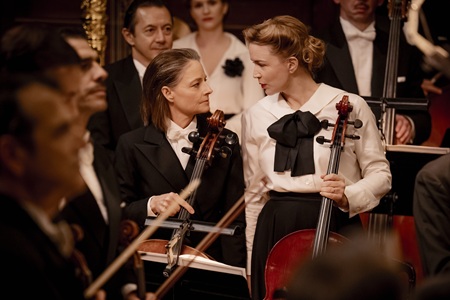
But there’s no point to any of this. No payoff. These are scenes designed to allow Lilian to garner fresh insight into how she’s been treating her patients (and, by extension, her loved ones), and while I get that was the intent, I still found them so maddeningly peculiar that they took me right out of the story. Part of me even wonders if Zlotowski removed a handful of scenes that may have allowed these hypnotically incongruous side moments to have some less ephemeral resonance, but I have zero idea if that’s the case. It’s like they are maliciously vague by design, and I find that frustrating.
The strange thing? I barely care. Even the feature’s mishappen, misbegotten shortcomings still brought a smile to my face. Zlotowski’s frisky handling of the material is difficult to resist, as are many of the romantic and comedic interludes that are liberally sprinkled throughout the proceedings. A Private Life is a lot of fun to watch.
As for Foster and Auteuil, their movie star magnetism is undeniable, and, whenever they share the screen, the film transforms into something timelessly essential. The word “perfection” doesn’t even begin to cover it.
– Review reprinted courtesy of the SGN in Seattle
Film Rating: 3½ (out of 4)