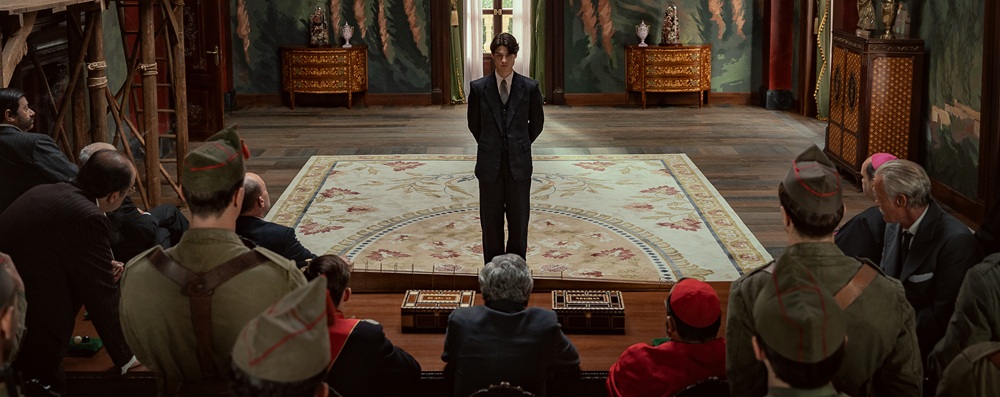
La Bola Negra (2026) 
by Sara Michelle Fetters - November 6th, 2026 - Four-Star Corner Movie Reviews
Sprawling Intergenerational Epic La Bola Negra is the Best Film of 2026
A sprawling generational epic that left me in the theater silently gobsmacked, La Bola Negra is a boldly ambitious masterwork of unparalleled imagination and emotional fortitude. Moving in non-linear fashion between 1932, 1937, and 2017, this rich tapestry of love, death, tragedy, rebirth, forgiveness, imagination, and resilience is a startling wonder. It’s a daring throwback to the wild days of Federico Fellini, Bernardo Bertolucci, and Luchino Visconti, snapshots in time where history was a springboard to multifaceted stories that defied easy categorization and dared to challenge audiences in ways they beforehand never dreamt were possible.
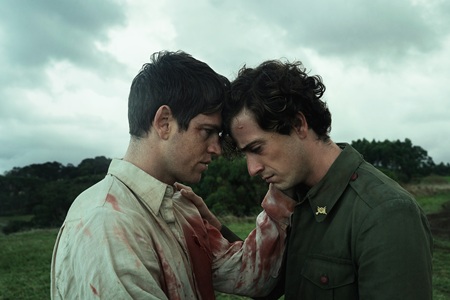
There are three interlocking stories, and directors Javier Ambrossi and Javier Calvo transition between them with captivating bravado. In 1932, dashing young Carlos (Milo Quifes), the son of a wealthy industrialist, is blacklisted from becoming a member of his township’s exclusive social club and casino because of the assumption that he is Gay. In 1937, Rafael (Miguel Bernardeau) is a soldier wounded fighting the fascists who is nursed back to health by his enemy and guarded by the conflicted Sebastián (Guitarricadelafuente). In 2017, historian Alberto (Carlos González) is sent down a mysterious rabbit hole of familial excavation when his deceased grandfather, living mysteriously alone in the countryside after abandoning his mother Teresa (Lola Dueñas) decades prior, leaves him a peculiar inheritance.
These pieces overlap and evolve symbiotically. Carlos’s tale is born from the writings of Federico García Lorca, most notably the very play the film borrows its title from. Sebastián’s descent into darkness, longing, lust, and heartbreak begins as an adaptation of the opening scene of playwright Alberto Conejero’s La piedra oscura and showcases the brutal obliteration of his entire village in the early days of the Spanish Civil War. Alberto’s story builds off of both of those segments, his grandfather having a previously unknown connection to Sebastián and Rafael’s tragic love story and is also the key to the location of Lorca’s missing, assumed destroyed play, La Bola Negra.
If any of this sounds confusing, please know it is not. Ambrossi and Calvo do an astonishing job of maintaining narrative clarity. I never got lost as to which year I was in and whose story I was currently following. It helps that the core of this epic belongs to Sebastián and Rafael, their doomed relationship developing in the middle of unconscionable bloodshed and destruction. Their connection, however, remains eloquently pure. They achieve a level of intimacy that, while it can never be consummated, still feels authentic, deserved, and utterly genuine. It’s a love that in a fairy tale world would probably move mountains. But in a stark, depressive landscape overrun by fascism and drowning in blood, a fleeting touch, an honest truth, or an urgent plea for selfless mercy will have to do.
Carlos’s saga is equally affecting. It’s a morality tale, to be sure, Lorca speaking on multiple planes as he deals with ideas of gender, sexuality, patriarchal biases, and economic inequality with sublime, metaphorically dense precision. But Ambrossi and Calvo still make this visually rambunctious flight of austere fantasy resonate like a punch to the gut. Carlos is a victim, but he’s also a determined hero. He fights for what he wants in life, even if, initially, he’s too timid to embrace any of it as fully or as tightly as he desperately longs to. Even when all hell breaks loose and carnage rains down around him, he refuses to stop fighting; whether this is to his ruin or to his salvation is up to the audience to decide for themselves
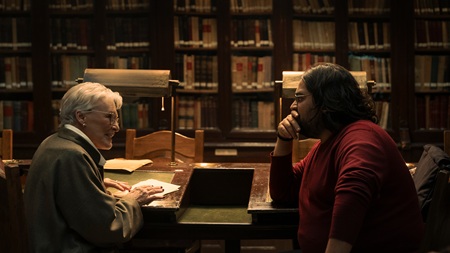
Alberto’s slice of the pie is arguably the most straightforward, but even that isn’t entirely true. Still, the historian is the figure in this melodrama who must assemble all of the fractured pieces back into a completed whole. He must learn from his mother why her father left and why his secrets left so many internal scars buried deep inside of her. Alberto has to make the journey to discover what it is he has been left in the will and, once he has it in his hands, journey again to meet another expert (a luminous Glenn Close in a small, but vitally important, role) in his chosen field to help him prove its authenticity. Ultimately, he is also the one who finally understands why Carlos, Sebastián, and Rafael are all so irreversibly joined at the hip.
The profound grace of it all took me by surprise. A sojourn by Alberto to a small café to chat with an elderly lawyer and their Transgender assistant is unexpectedly haunting. Carlos’s daring climb to the top of a snowy mountain peak as he rises from the depths of purgatory into the bright lights of an undiscovered heavenly country had me choking back tears. Sebastián’s impromptu dalliance with a traveling actress and sometimes prostitute (superbly embodied by a scene-stealing Penélope Cruz) packs an impactful wallop and puts so much of what’s going on right here, right now in 2026, not just inside the maelstrom of the Spanish Civil War, into searing, bone-chillingly bleak perspective.
While every member of the ensemble is outstanding (and, even though they do not share a single scene, it’s also awesome to see Pedro Almodóvar muses Cruz and Dueñas in the same film for the first time since Broken Embraces), it was newcomers Guitarricadelafuente and Quifes who impressed me most. Each actor is making their feature debut, delivering soaring performances that are stratospherically elevating in their emotional and physical dexterity. They are extraordinary.
The film is also an across-the-board technical marvel. From the visual effects to the production design, the costumes to the set direction, the editing to the score, every element works in melodious symmetry with all that surrounds it. Special mention must be made of the work of cinematographer Gris Jordana. She achieves an old-school visual grandeur reminiscent of the colorfully tactile majesty of Giuseppe Rotunno’s legendary camerawork on Fellini’s Amarcord or Visconti’s The Leopard. It deserves to be witnessed on the biggest screen possible.
There’s so much more I could add, but I think I am going to leave things here: La Bola Negra is the best film of 2026. What else is there to say?
– Review reprinted courtesy of the SGN in Seattle
Film Rating: 4 (out of 4)