

Waititi’s Insufferably Twee Klara and the Sun Adaptation is a Robotic Disaster
In the near future, artificial friend Klara (Jenna Ortega) is purchased by wealthy interior designer Chrissy (Amy Adams) as a companion for her loner daughter, Josie (Mia Tharia). The pair hit it off. Josie is fascinated by the wide-eyed, innocently naïve synthetic being. Klara is equally infatuated with her new human compatriot and is determined to do whatever is necessary to make her life a happy one.
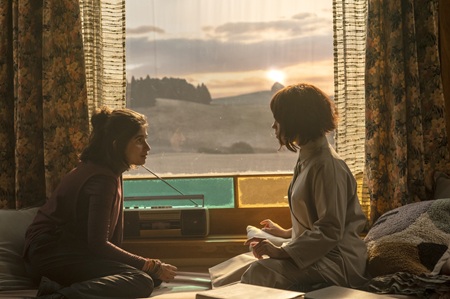
Adapted from the best-selling 2021 novel by Nobel Prize-winning author Kazuo Ishiguro, Klara and the Sun is a frustrating misfire. Written and directed by Taika Waititi (Jojo Rabbit), the filmmaker’s signature quirky, melodramatically comedic style never quite seems to be in harmonic sync with the story. He imagines Klara as some pixie magic dream girl robot, and any insights regarding humanity, artificial intelligence, genetic engineering, climate change, or anything else substantive get lost amidst all the turgid, superficially facile jolts of whimsy, silliness, and overt emotional manipulation.
Comparisons to Terry Gilliam’s Brazil or Steven Spielberg’s A.I. Artificial Intelligence are obvious, but a better one is to 1999’s Bicentennial Man starring the late Robin Williams. Like that sci-fi drama, the treacle gets laid on thickly. Also like that one, any broader points are buried under too many layers of schmaltz. By the time Waititi attempts to wrap everything up in a tidy, sentimentally semi-tragic bow, I’d stopped caring about what was going to happen to Klara, Josie, or any of the other characters who populated this strange little futuristic cautionary tale altogether. Part of me even wanted to throw something at the screen in disgust.
But that’s not entirely fair. Waititi is too talented for his adaptation to be a total catastrophe. There are moments where I could clearly see what he was hoping to accomplish. Early scenes in the store where Josie and her fellow artificial friends are up for sale are fascinating, and Natasha Lyonne’s brief turn as the boutique’s world-weary store manager is sublime. There is a nice balance between the glib, goofy jokes and the inventively bleak ingenuity of the visuals during this opening section that captured my attention. I was eager to see where things were going to go next.
Newcomer Tharia is also quite good as Josie. I liked how she balanced her character’s travails with subtle, almost effortless gravitas. The teen is dealing with several issues, not the least of which is her sadness over her mother’s inability to properly grieve over her older sister’s death years prior. This is coupled with the realization that her own illness — brought about by having her intellect genetically augmented — may be more serious than anyone is willing to tell her. Tharia achieves an internalized authenticity that’s striking, and as fake as so much of Klara and the Sun felt, her captivating complexity happily rang true.
Yet, for every intriguing moment or strong character beat, there are several others that fail to make the grade. There’s a prominent set piece where Josie has a party to interact with other kids who have had their intellects boosted, and the sequence lands with a massive leaden thud. Waititi gives in to all of his worst instincts. The comedy is like something out of a bad improvisational skit. The costume, hair, and makeup designs for the kids are like some horrible parody of a third-rate Tim Burton production. Nothing about this scene works, and considering how essential it is as a lead-in to the film’s climax, that only makes its awfulness all the more egregious.
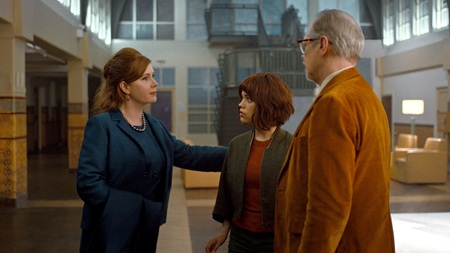
I do give Ortega props. She gives the type of freewheeling, go-for-broke performance I cannot say I’ve ever seen from the young star. This is about as far removed from her work in Wednesday, The Fallout, or Death of a Unicorn as the actor could get. She doesn’t hold back, enthusiastically giving herself over to Waititi’s vision body and soul, delivering a relentlessly cheery and gregariously upbeat portrayal of robotic simplicity. Even when Klara is sad, Ortega’s optimistic fervor is ever-present. It’s always there, no matter what.
There is a case to be made that Waititi’s form of magical realism intermixed with dystopian social commentary isn’t exactly “critic-friendly,” and I can’t say I would disagree with that assessment. But I also think there is something decidedly wrong with how the filmmaker has tackled Ishiguro’s source material. Greater insights into this world, these characters, and how it all relates to what is happening in the here and now are difficult, if not impossible, to ascertain. It’s an impenetrable muddle, and this doesn’t just make Klara and the Sun disappointing, but, even worse, an insufferably twee disaster as well.
Film Rating: 1½ (out of 4)