

Tense Whalefall Goes Inside the Belly of the Beast
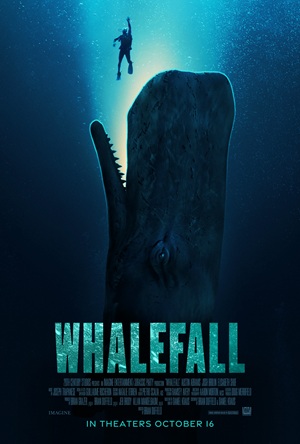
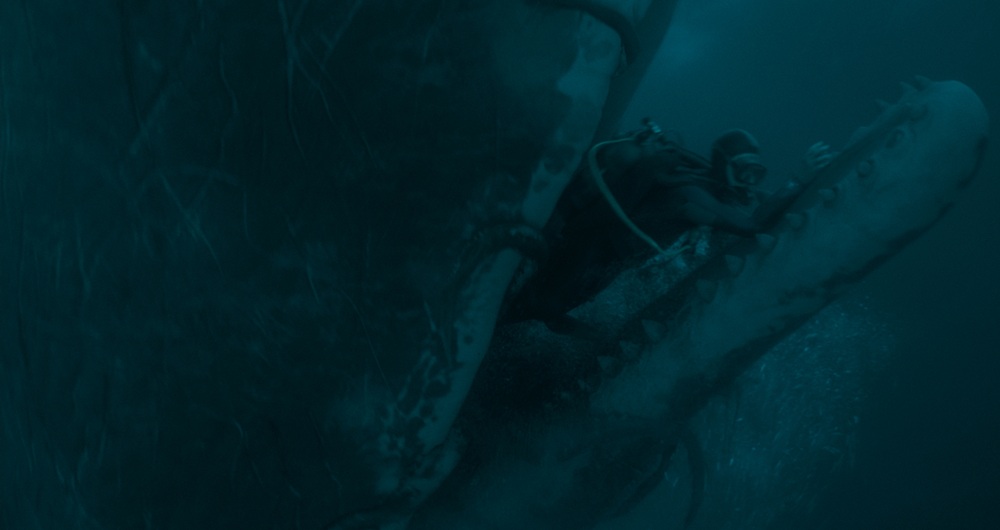
The plot of Whalefall couldn’t be simpler: While out alone searching for the remains of his grizzled seaman father, Mitt (Josh Brolin), scuba diver Jay Gardiner (Austin Abrams) gets swallowed by a giant sperm whale. With the odds stacked against him and less than an hour of air in his tank, the young man must use all his wits — and every lesson his dad ever taught him about the undersea world — to survive.

Author Daniel Kraus made a splash with his best-selling 2023 novel. This wasn’t just a “Jonah in the whale” meets Pinocchio variation. Instead, it was a wonderfully immersive fish tale of fathers, sons, grief, the natural world, ecological imbalance, and feats of ingenious daring-do. A fast-paced, engrossingly mesmeric read, Kraus’s prose is littered with haunting insights that brought me to tears as it jumped back and forth between Mitt and Jay’s complicated relationship and then the latter’s herculean attempts to literally free himself from the belly of the ocean’s most majestic resident.
Of course, while the central scenario is undeniably cinematic, the trap any filmmaker could inadvertently stumble into while adapting this novel is to overplay the melodramatic elements to the point they become annoyingly schmaltzy. Thankfully, director Brian Duffield (Spontaneous), who co-wrote the sturdy screenplay with Kraus, mostly manages to avoid this. His thriller isn’t some deep-sea soap opera. Instead, he crafts a claustrophobic, sweat-inducing underwater survival epic that’s interspersed with haunting, authentically affecting interstitials reminiscent of Phil Alden Robinson’s baseball classic Field of Dreams of all things. All it’s missing is a scene of Jay and Mitt playing catch.
The result is an emotional, heartrending ride that builds to a suitably explosive climax, all of it revolving around another winning performance from Abrams that’s even better than the one he delivered barely a month ago in Zach Cregger’s Resident Evil. Forced to use a variety of expressive facial contortions, his physical dexterity, and understandably few coherent words (but several grunts, groans, and a handful of distraught screams), the actor does a superb job of conveying the sheer, unimaginable horror Jay must directly face (and subdue) if he’s going to escape being digested. He’s excellent.
Still, there’s no question the first two-thirds are far better than the last third unfortunately turns out to be. Part of that is due to Kraus’s source material. The author imagines some fantastical, undeniably harrowing sequences of terror. But while almost all of them resonate on the page, allowing the reader’s imagination to go wild, they’re not nearly as successful when depicted cinematically. Worse, some fall hopelessly flat.
A notable example is an attack by a pod of orcas. While it looks incredible — Duffield pulls out all the stops to showcase the whale’s sonar capabilities and the brutal efficiency of the orcas as they strike their defenseless target in the pitch-black underwater nothingness — there’s also no real urgency to the sequence. It lacks emotion, suspense, or intensity, and as this is a pivotal moment, and where this part of the book had me on the edge of my seat, having it fall so inert here was frustrating.
But the flashbacks depicting Jay and Mitt’s thorny relationship are quite effective, Brolin commanding the screen with bearish gravitas. The simplicity of scenes featuring Elisabeth Shue, Jane Levy, and Emily Rudd also warmed my heart, and while the trio doesn’t have a lot to do, they still fill their few moments with understated familial grace, Shue in particular.
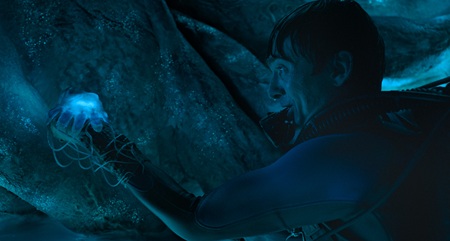
Then there are the technical facets. The visual effects are beyond reproach, and Duffield stages the set piece where Jay accidentally (stupidly?) gets involved with the whale as it hunts its morning breakfast with cruel, horrifying tenacity. Production designer Ramsey Avery (10 Cloverfield Lane) does a stupendous job crafting the ooey-gooey insides of the mammal itself, while Oscar-winning editor Pietro Scalia (Black Hawk Down) manufactures a palpable sense of doomed determination that crushes down upon the proceedings with disquieting inevitability.
Ultimately, though, it are the human elements that makes the film worthwhile. As in the book, Duffield understands that without Jay and Mitt’s backstory, the inherent silliness of the situation the protagonist finds himself facing would overwhelm the proceedings and maybe make watching what happens after he’s swallowed into an unintentional comedy. It’s his grief that leads Jay to make some boneheaded mistakes and several errors in judgment. But it his unbreakable connection with his dad that gives him the resilience and the fortitude to keep fighting when all hope has seemingly been lost. Because of this and more, Whalefall works.
– Review reprinted courtesy of the SGN in Seattle
Film Rating: 3 (out of 4)