a SIFF 2026 review
Carney’s Power Ballad Hits the Entertainment Charts with a Bang
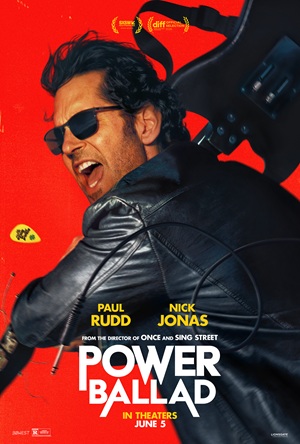
Rick Power (Paul Rudd), an American expat who gave up his rock star dreams to marry the love of his life, Rachel (Marcella Plunkett), and be a good dad to his now teenage daughter Aja (Beth Fallon), is the lead singer for British wedding band The Bride and Groom. He just spent one of the greatest nights of his life jamming with international pop superstar Danny Wilson (Nick Jonas). This happened after the group’s latest gig, a lavish evening at a countryside estate straight out of Downton Abbey, where the latter was one of the attendees (and ended up as an impromptu guest performer). Rick and Danny hit it off, and the pair spent the subsequent evening (and early morning) chatting, drinking, and jamming as if they were old friends.
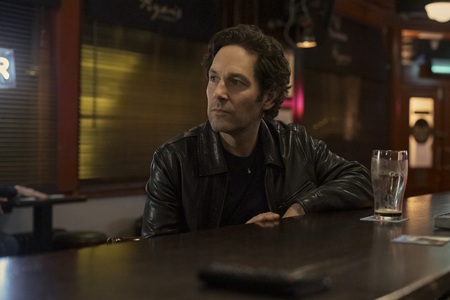
Some months later, while shopping at the mall, Rick hears a song playing in the background. It’s Danny’s latest single, and it’s catchy, heartfelt, and expertly produced, and it’s going to be a massive hit. But it is also built upon a chorus that Rick wrote, shared with Danny the night they were together, and did not give the singer permission to use. Worst of all, Danny didn’t give Rick a co-writer credit.
On the surface, Power Ballad, the latest musical drama from Once, Begin Again, and Sing Street filmmaker John Carney, appears to be an aggressively exuberant — if highly familiar — workplace adventure where a determined individual has to prove he’s been horribly wronged by a coworker who seems to have all the marbles. Will Rick confront Danny? Can he prove the song is his? And will any subsequent financial windfall that could set him and his family up for good come their way?
If this film were nothing more than a Horrible Bosses, Secret of My Success, or Working Girl clone (just set in the music world), there probably wouldn’t be a lot to talk about. Entertaining? Certainly, especially with Rudd and Jonas delivering such full-bodied, richly layered performances. Even so, I’m not sure the drama would have an ounce of lasting impact if that were the case.
Thankfully, and unsurprisingly, Carney is eager to dig a bit deeper. For Rick, this is a midlife crisis story where the wedding singer is looking for validation, not so much a big payday (although that would be nice, too). He wants to know he hasn’t wasted decades of his life struggling in a profession he should have moved away from long ago. All Rick wants is credit for co-writing the song because, if nothing else, he thinks that will give Rachel and Aja a reason to be proud of him.
The point, then, is for the musician to discover that his family is already proud of him, and that the validation of a hit song doesn’t change one iota the love they all share. It’s up to Rick to learn that, by staying, by becoming a father, his dreams of becoming a rock star weren’t so much ended but changed. His passions for music became intertwined with his commitment to being there for all the unknowable ups, downs, and in-betweens that the birth of a child brings. The reason he could write a powerful song that Danny could transform into a hit is precisely due to Rick making the decisions that he did, and it’s the journey to get to this realization that gives Carney’s latest its euphoric intimacy.
The other half of the story is about Danny and his reasons for stealing the song in the first place, and, as good as Jonas may be as the beleaguered singer, this is the far less interesting section of the film. Carney’s examination of the price and pressure of fame, while honest, doesn’t hit with the same introspective authority Rick’s plotline does. There’s nothing happening during these sections that hits with any lasting significance.
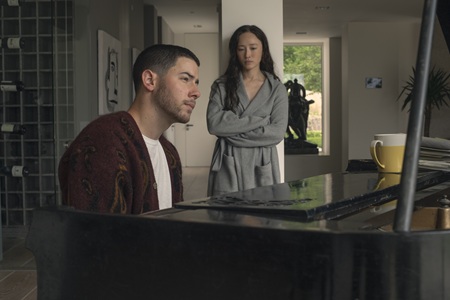
It does not help that Jack Reynor is strangely inert as Danny’s cantankerous manager, Mac, or that Havana Rose Liu is frustratingly underutilized as his girlfriend, Marcia. The former delivers a one-note performance that became increasingly annoying as events progressed. The latter has this sensational moment where Marcia overhears Danny playing around with the song out of exhausted aggravation, and her sincerely raw reaction to hearing the chorus for the first time is achingly powerful. But Liu is an ephemeral presence before this scene at best, and then disappears almost immediately after it has concluded. I found all of that unfortunate.
Yet happily not that unfortunate. While Rudd has given several strong performances, most notably in pictures as diverse as Prince Avalanche, The Perks of Being a Wallflower, The Catcher Was a Spy, and even Ant-Man, this is his best work. The actor balances comedy and drama with magnetic aplomb, and his scenes with Plunkett and Fallon are notable for their emotional dexterity. He also has incredible chemistry with Jonas, the pair bouncing off one another with a refreshingly airy elasticity that’s intoxicating.
The remaining components are up to par with anything Carney has ever made. The songs are universally great (the variety between the original tunes and familiar wedding pop standards is spot-on), cinematographer Yaron Orbach (who also shot Sign Street and Begin Again) gives things a free-flowing visual panache that fits this world perfectly, and editor Stephen O’Connell (Flora and Son) cuts it all together beautifully. Carney also builds things to a sensational conclusion, one of the best I’ve seen in all of 2026. It’s a moment of joyful discovery captured with such naturalistic surprise I wanted to rise from my seat and cheer.
Power Ballad hits the cinematic charts with a bang. Give it a listen (and a look).
Film Rating: 3 (out of 4)